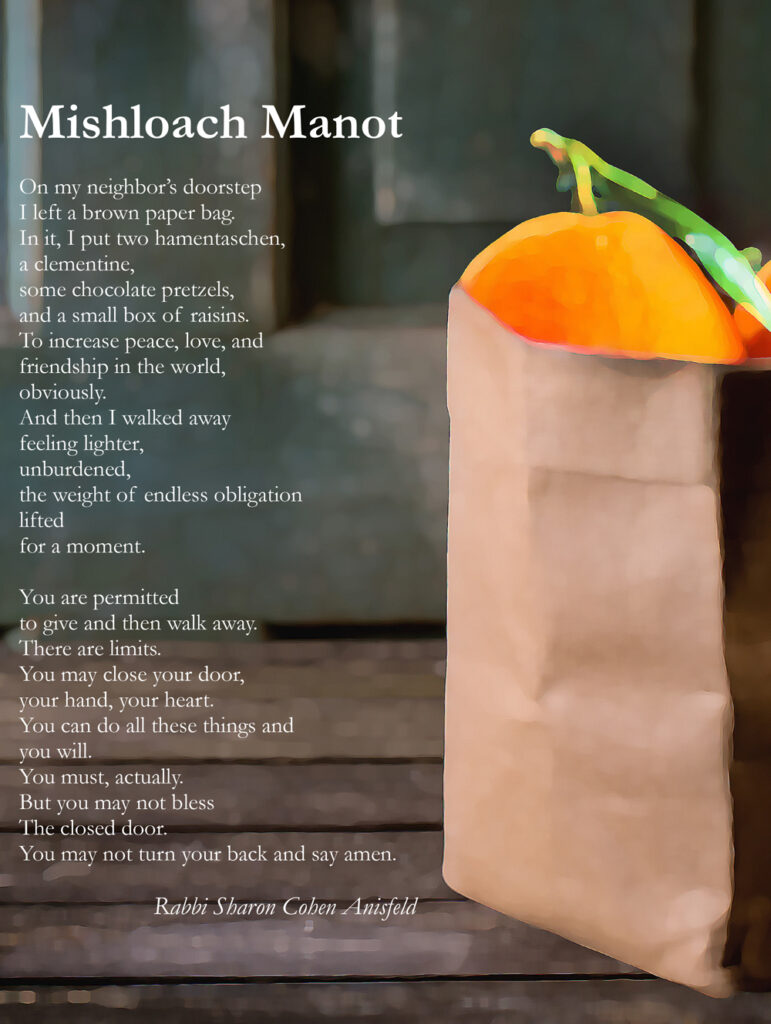
Purim Mishloach Manot

One of my favorite practices on Purim is the mitzvah of mishloach manot — delivering gifts of food to friends and neighbors. Rabbi David Hartman z”l relates this mitzvah to the fact that the Book of Esther, which we read on Purim, does not mention the name of God.
Purim speaks to all those times and places in which it is difficult to discern the presence of the divine in our world. For Hartman, the obligations of Purim teach us that the religious response to the hiddenness of God is radical human responsibility. What do we do when we can’t see God’s face? We turn our faces toward each other; we take care of each other by delivering gifts of food to friends (mishloach manot) and by giving tzedakah to the poor (matanot la’evyonim).
Why don’t we say a blessing over the mitzvah of mishloach manot? According to the Seridei Esh, R. Yaakov Yechiel Weinberg, the mitzvah of mishloach manot is intended to increase peace, love and friendship in the world — and as such, it is amitzvah t’midit — a perpetual mitzvah that is incumbent upon us at all times and has no break. It is a mitzvah we can never say we have fulfilled, a mitzvah over which we can never say amen.