

Holidays Opening Our Broken Hearts: How Do We Celebrate Simchat Torah After October 7?
How do we celebrate Simchat Torah after October 7?
How do we sing, dance, and celebrate with the memory of the brutal massacre that took place on that day? How do we sing, dance, and celebrate with the awareness of the terrible violence and immense suffering that has unfolded during the years of war since then?
For many of us, even from the safe distance of our homes here in the United States, the searing memory of that dark morning is still with us. For those who lost their homes, their beloved family members and friends, their sense of safety in the world, the memory of that dark morning has changed them forever.
We cannot celebrate Simchat Torah as though nothing has changed. But we can and must choose how we celebrate, what we celebrate, and why we celebrate on this day.
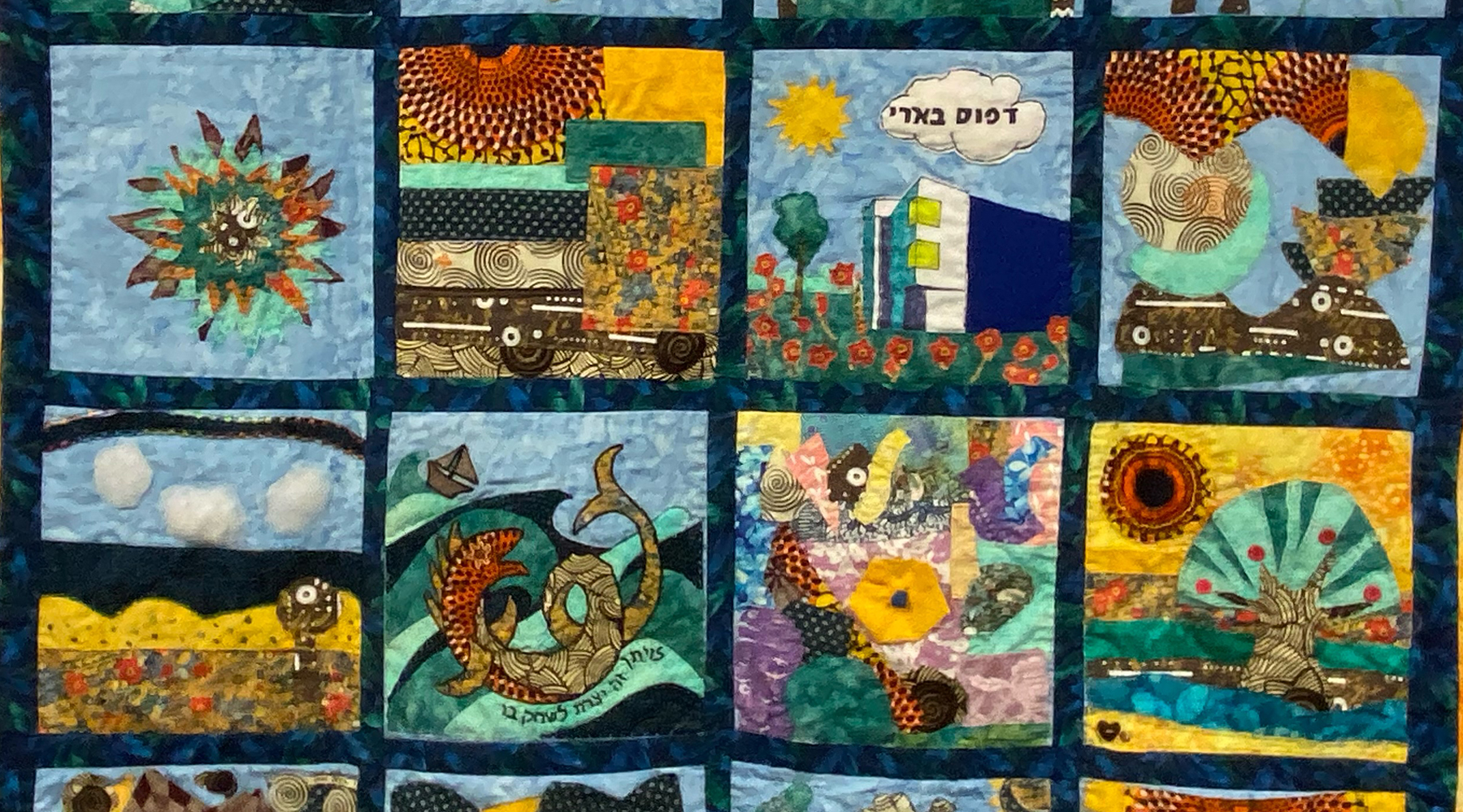
Last year, I had the opportunity to participate in a quilting project organized by four members of my minyan, the Walnut Street Minyan in Newton. They had been inspired by meeting a member of Kibbutz Be’eri who miraculously survived the horrors of October 7 with her husband and four children. My fellow minyan members thought it would be meaningful to create a handmade quilt on the theme of B’reishit, the Book of Genesis, which we begin reading again on Simchat Torah — “a gift of love from a diaspora community to an Israeli community on the road to recovery.”
I felt honored to be one of the people from our minyan who participated in making the quilt. I was a total novice at the art of quilt-making, but working on my square became a true labor of love — and even joy.
We each sent a message along with our square. This was my message to the community of Kibbutz Be’eri:
“I was so grateful to have the opportunity to contribute a square for this quilt — a gift from our community to yours. As I selected the fabrics and stitched them together with glistening threads of silver and gold, my kavanah was simple: as we begin the cycle of another year since the dark Shabbat of October 7, I wanted to offer you an image of the world shimmering with light, from above, below, and within us. I also wanted to evoke the continual possibilities of beauty and renewal in the natural world as a blessing for the possibilities of beauty and renewal in your own lives. And I wanted you to know that I continue to carry you in my heart with much love — and always will.”
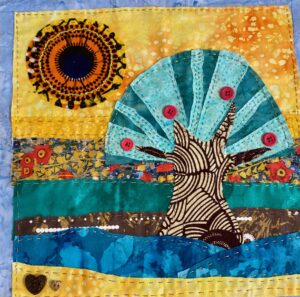 As we mark the third Simchat Torah since that dark morning, this is still my message and my kavanah — not only to the community of Kibbutz Be’eri, but to all of us. We cannot possibly roll time back. But as we roll our Torah scrolls back to the beginning of B’reishit, can we reconnect with the possibility of beauty and renewal, in our own lives and in the world around us? As we dance and carry the Torah scrolls in our arms, can we carry each other in our hearts with love? As we mark this day, can we remember October 7 without allowing it to become the only story we tell about ourselves?
And, as we move into Simchat Torah this year, there are still more questions weighing heavily over our celebrations — questions about the rise of global antisemitism since October 7, questions about the ongoing effects of PTSD among Israelis, questions about the ongoing suffering of children and other innocents in Gaza, questions about the horrific wave of Jewish extremist terror being waged against Palestinian homes and villages in the West Bank.
There is a struggle going on now in which, whether we like it or not, we all have a part to play — a struggle for the soul of the Jewish people, for the soul of Judaism. We cannot control or undo what has happened to us. But we can still ask what we will nurture in its aftermath.
Will we let the hatred of our enemies define us, or will we be defined by our love for one another? Will we let the darkness of antisemitism define us, or will we insist on creating sparks of light through our words and our deeds? In the garden of Torah and Jewish life, what will we choose to water? Who will we be with one another? What kind of communities will we build? What kind of Judaism will we practice and pass on?
At the end of the day, the most meaningful part of Simchat Torah for me is not the drinking and dancing and singing and raucous celebration.
It is the moment when we roll the Torah scroll all the way back to the beginning.
We arrive at the end, and then we begin again.
.בְּרֵאשִׁית בָּרָא אֱלֹהִים
B’reishit bara Elohim.
In the beginning.
Again.
Another year of sacred learning. Another year of life.
The world we enter is not the world we entered last year. We are not the people we were last year. The Torah has not changed — and yet, because we have changed, the words meet us differently.
There is one more detail about the Torah reading on Simchat Torah that I find especially meaningful.
The last letter we read at the end of the Book of Deuteronomy is a lamed — the last letter of the word Yisrael. The first letter we read at the beginning of the Book of Genesis is a bet — the first letter of B’reishit. Together, they form the Hebrew word lev — heart.
This is the beginning and the end of Torah — the ongoing process of opening our hearts.
May the Torah we celebrate on this Simchat Torah, and the Torah we study throughout the coming year, be a Torah that opens our broken hearts — to each other, to all who seek peace, and to all who choose life.
Chag Sameach,
Rabbi Sharon
P.S. As we prepare to celebrate this Simchat Torah, I want to extend a heartfelt personal invitation to everyone reading this: consider marking this Simchat Torah by choosing to make Jewish learning part of your life this year. Whether you are new to Jewish learning or have been doing it for years, Hebrew College is here for you. We’re here, and we’re not going anywhere. Our Beit Midrash is your Beit Midrash. Take a moment and sign up for a class today. Or give us a call and schedule a time to come visit. To learn more and register, click here.
Rabbi Sharon Cohen Anisfeld is President of Hebrew College in Newton, MA.
 Meet students and faculty at one of our fall open houses, Ta Sh’ma (Come & Hear) November 16 (in-person) or online (Dec. 6).
Learn more and register.