

Genesis Just Human
Parashat Chayei Sarah (Genesis 23:1-25:18 )
“If only you would listen to me” (Gen. 23:13)
Abraham pleads with Ephron to allow him to purchase the burial plot
Religion, or tribal mythology, is humanity’s attempt to understand the world around us and to find some possibility of control over our own lives. Thousands of years ago, humans looked out into a terrifying and chaotic world. Dangers lurked in every shadow, sickness struck inexplicably, blight or famine was always possible, and they tried to make sense of it, to create order out of chaos within their own minds. Out of this comes our Torah, our traditional understanding of our world and of what we are doing here. It is no surprise that our creation story focuses specifically on ordering chaos, something humans can attempt to replicate in our own lives. Torah, and religion in general, is a mirror we hold up to see ourselves more clearly.
Parshat Chayei Sarah, “the life of Sarah,” begins with her death, which cannot be separated from the trauma surrounding it. Rashi expounds on Genesis 23:1, telling us that when Sarah learned that Abraham had almost sacrificed their son Isaac, the shock caused her soul to fly from her body. It was the direct actions of her husband that caused her death: the realization that Abraham could do such a thing, and would have, had the angel not stopped him. She hears this, and her soul departs.
Abraham is left to deal with the consequences of his actions. Louis Ginzberg writes in Legends of the Jews that “the death of Sarah dealt Abraham a blow from which he did not recover. So long as she was alive, he felt young and vigorous, but after she passed away, old age suddenly overtook him.” He, too, realizes his role in her death, how his actions caused her more harm than anything else could have. Whether or not he did the right thing — if being prepared to sacrifice his son was truly what God wanted, and he passed the Divine test — he must deal with the earthly consequences.
One of those consequences is that Abraham is alone when Sarah dies. Abraham and Isaac went up the mountain together, but they did not return together. Abraham goes down to his servants by himself while Isaac goes a different way. While we know they reunite for Sarah’s funeral, they never speak to each other again in our text. This is another consequence Abraham must carry.
As many of us know, when a loved one dies there are things we must do, and sometimes that includes finding a burial plot. Abraham now must find a fitting resting place for Sarah. He goes to the Hittites, among whom he is a respected prince, and asks to purchase a burial plot. What follows is a back-and-forth negotiation: the Hittites offer to give him the land for free, but Abraham insists on paying full price:
“No, my lord, listen to me. I have given you the field, and the cave that is in it, I have given it to you. Before the eyes of the sons of my people, I have given it to you; bury your dead.” And Abraham prostrated himself before the people of the land. And he spoke to Ephron in the hearing of the people of the land, saying, “But, if only you would listen to me. I am giving the money for the field; take [it] from me, and I will bury my dead there.” And Ephron replied to Abraham, saying to him, “My lord, listen to me; a [piece of] land worth four hundred shekels of silver, what is it between me and you? Bury your dead.” And Abraham listened to Ephron, and Abraham weighed out to Ephron the silver that he had named in the hearing of the sons of Heth, four hundred shekels of silver, accepted by the merchant. (Gen. 23:11–16)
Ephron and Abraham both implore each other to do the same thing: listen. Ephron tells Abraham that he doesn’t need to be paid, that this is a gift Abraham should accept. But Abraham pleads with Ephron to listen to him: he must pay. There is something inside him that will not accept such a gift.
After all, it is because of Abraham’s reputation and actions that he is honored among the Hittites and offered such a gift in the first place. Yet it was also his actions that caused his wife’s death. It was his decision that drove her son away and destroyed part of their family. His dedication to God overpowered his dedication to his earthly family, and that is a reality he will live with forever.
Abraham is not arguing about a monetary price, but about the price of his own soul. The question is what his own conscience demands of him, not what God commands. In this moment, Abraham is a grieving husband and father who is profoundly alone, trying to find a foothold of control in his situation.
“If only you would listen to me.” Abraham pleads for Ephron to understand that he must purchase this burial plot. It is the only control over his situation he can exert. His son is gone, processing his own trauma of nearly being sacrificed. His wife, his dedicated partner, is dead because of that same decision. For someone who values family so much, this must be an incredibly painful time. The only thing Abraham can control is insisting on paying his fair share, as if he were someone without status. In this moment, Abraham is not the prince the Hittites see, nor the prophet who speaks with God. He is a human being just trying to find his way in the world.
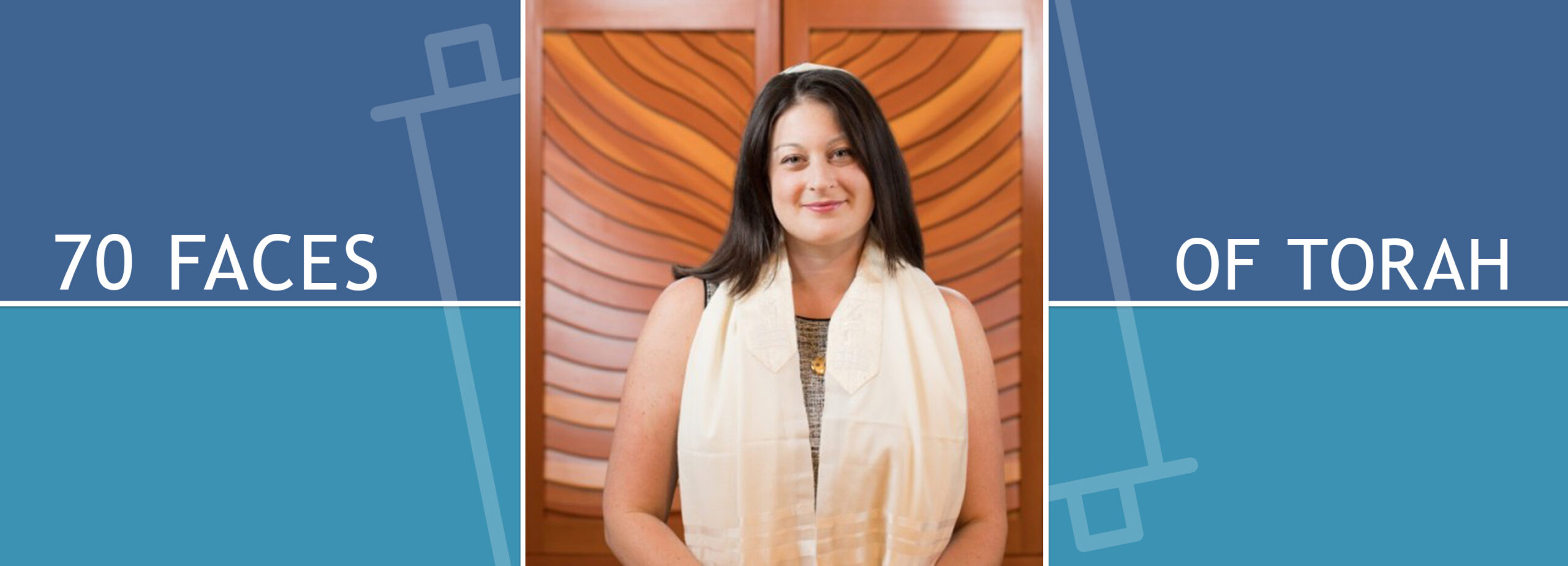
Rabbi Jessica Lowenthal was born and raised in Framingham, MA. She attended George Washington University, graduating with a BA in religion and psychology. Rabbi Lowenthal graduated from the MBA/MA program at Hornstein at Brandeis University. Rabbi Lowenthal was ordained by Hebrew College in 2019 and came to Temple Beth Shalom that fall. She had previously worked for AJC and ADL New England.
Rabbi Lowenthal speaks extensively on the history of early Zionism and Israel, Second Temple Judaism, Talmud and other topics. She co-teaches Conversations Unpacking Whiteness, a 5 week course offered multiple times a year. She leads a program with TBS’s Children of Holocaust Survivors at various schools and has been a guest teacher at local public schools to teach on Antisemitism.
Rabbi Lowenthal is a contributing writer for Shalom Magazine and a guest host for the Speaking Torah podcast produced by Hebrew College. She was part of the Hillel Rabbinical Fellowship, Rukin Rabbinic Fellowship through 18 Doors, and the Amplify Israel Fellowship through the Stephen Wise Free Synagogue.
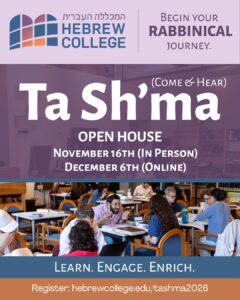 Meet students and faculty at one of our fall open houses, Ta Sh’ma (Come & Hear) November 16 (in-person) or online (Dec. 6).
Learn more and register.