

Genesis Serving Supper to the Shekhinah
Parashat Vayera (Genesis 18:1-22:24)
What would it be like to serve God supper?
In a sense, Avraham and Sarah have just this experience at the beginning of Parshat Vayera.
Vayera is filled with dramatic and heart-wrenching stories: the miraculous birth of Yitzchak, the expulsion of Hagar and Ishmael, and finally the Akedah, Avraham’s near-sacrifice of Yitzchak.
Yet Vayera begins somewhere gentler, with a locus classicus for the middot of gemilut chasadim, bikur cholim, and hachnasat orchim that characterize the Abrahamic relationship with God.
Avraham sits at the entrance of his tent in the heat of the day, recovering from his circumcision, when “Vayera eilav Hashem”—God appears to him (Genesis 18:1). We do not read how God manifests to Avraham or what God says. Instead, Avraham looks up and sees three men approaching through the desert.
He runs to attend to them and cries, “Adonai, im na matzati chen b’einecha, al na ta’avor me’al ‘avdecha”—“My lord, if I have found favor in your eyes, please do not pass by your servant” (18:3).
But to whom is Avraham speaking?
Rashi presents two possibilities. Perhaps Adonai, “my lord,” is chol, an ordinary address to the most prominent of the three visitors. Or perhaps Adonai is kodesh, the divine name: Avraham asks the already-present Shekhinah not to depart while he attends to his guests (Rashi on Genesis 18:3). From this second reading, the Talmud famously teaches that welcoming guests is even greater than receiving the presence of the Shekhinah (Shabbat 127a).
Yet perhaps the ambiguity itself teaches us something. Is Avraham addressing God, or the stranger whom he hopes to feed? The Torah allows us to hear both.
Avraham invites his visitors to wash their feet and eat a little bread. Then he and Sarah hurry to prepare an extravagant meal: cakes, a choice calf, curds and milk. Avraham stands over the visitors as they eat (Genesis 18:4–8).
And this, too, is strange. These three “men” are malachim, angels, who have come on divine missions. Why should angels eat?
Elsewhere in Tanakh, an angel comes to announce the miraculous birth of Shimshon. Manoach offers him food, but the angel refuses: “If you detain me, I shall not eat your food” (Judges 13:15–16). The Talmud therefore suggests that Avraham’s visitors merely appeared to eat and drink (Bava Metzia 86b). Other Jewish interpreters, however, take the Torah’s simple statement seriously: “vayochelu”—“they ate.”
The early twentieth-century Romanian Hasidic leader Rabbi Yisrael Shalom Yosef Friedman of Bohush offers a striking interpretation. Like tzaddikim—people who strive to live sacred lives in pursuit of righteousness—angels can partake of the physical pleasure of food, elevating the holy sparks of divine light within it.
This interpretation changes the question. We ask not only whether angels are capable of eating, but what eating means when directed toward holiness. Physicality opens up a different sense of spirituality. Eating itself becomes an avenue to connect with God.
The meal does not interrupt the encounter with God. The meal becomes a place of encounter with God.
The Rabbis of the Mishnah extend this possibility from Avraham’s tent to our own tables. Pirkei Avot teaches that when three people eat together and share words of Torah, it is as though they have eaten mi-shulchano shel Makom—“from the table of the Omnipresent” (Pirkei Avot 3:3). Through blessing, gratitude, and conversation about Torah, an ordinary table can become a reflection of the Divine table.
Hosting Shabbat meals has become one of the great loves of my own embrace of Jewish life and observance. While my love for Torah, Tefillah, and Jewish community brought me to full-time Jewish learning and then Rabbinical school, Shabbat and holiday meals solidified my sense that spaces we share in our own homes are equally important sites of spiritual encounter.
Shabbat affords us a measure of slowness and intentionality that helps us savor our food and attend to one another with patience and kindness. Perhaps we uncover sparks of holiness in the meal itself—and in the people gathered around the table.
In this sense, the extraordinary hospitality of Avraham and Sarah becomes part of the rhythm of Jewish life. We, too, can serve the Shekhinah supper when we eat supper together.
Our meals are different. We do not serve milk and meat together as Avraham and Sarah did. But we can invite family and friends, neighbors and community members. We can make blessings of gratitude for food in abundance, sing and speak words of Torah, share questions and stories. In doing so, we can meet something of the Divine Spirit in the people with whom we share this ruach of chesed and in the pleasure and delight—the oneg—of the seudah itself.
Eventually—hopefully after we bench—we get up from the table.
Vayera does not remain in the warmth and abundance of Avraham and Sarah’s tent. The parsha proceeds into some of the most difficult stories of their lives: Sodom and its destruction, the expulsion of Hagar and Ishmael, and finally the terror of the Akedah.
The generosity and hachnasat orchim that Avraham and Sarah share with these divine messengers do not negate the more difficult parts of vayera. But they offer an anchor of generosity, sustenance, and connection with which to weather them.
Our lives do not remain at the Shabbat table either. So too in our lives as b’nei Avraham v’Sarah, we eat together. We sustain one another. We speak words of Torah together. We share light and hope, questions and stories to accompany us through the twists and turns of this life.
May our homes be open wide to guests like the tents of Avraham and Sarah.
May we savor our sweet companionship as we savor delicious and nourishing food. And May we discover sacred sparks of the Divine Presence as we open our homes to each other.
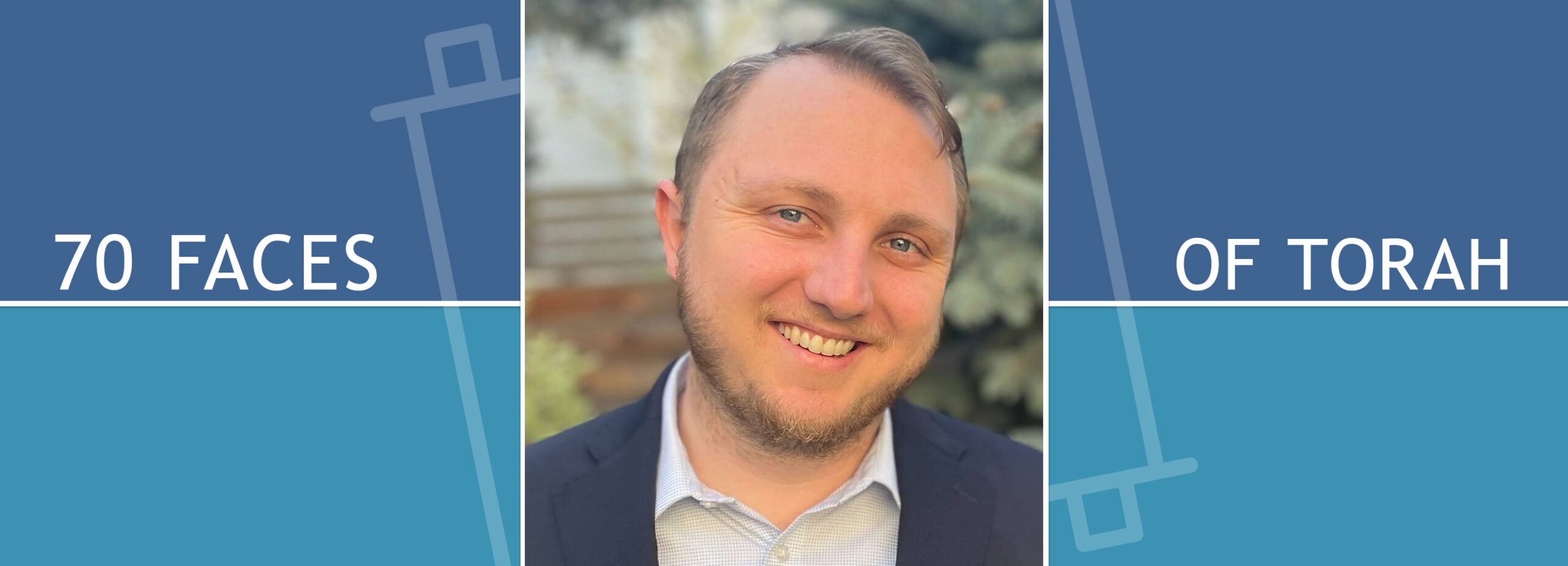
Rabbi Micah Friedman is a Jewish educator who lives in Ithaca, New York with his spouse Rabbi Talia Laster. R’ Micah designs Jewish learning experiences that weave together Torah, Rabbinic sources, and contemporary questions, in ways that are highly accessible and intellectually rigorous. He serves part-time as Rabbi of Temple Israel of Vestal, New York a modern, egalitarian synagogue in Vestal, New York and is engaged in multiple writing and translation projects oriented towards making complex texts accessible and personally meaningful. He was ordained at Hebrew College in Newton, MA, and has also studied at Pardes, Hadar, Drisha and Yashrut in New York, Jerusalem, and online, experiences that inform his commitment to passionate text study in an open beit midrash where all questions are on the table. You can often find him sitting with a book, singing a niggun, or hiking in the woods.
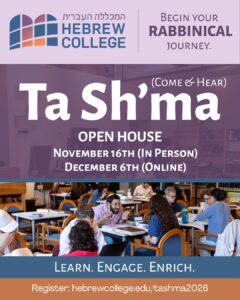 Meet students and faculty at one of our fall open houses, Ta Sh’ma (Come & Hear) November 16 (in-person) or online (Dec. 6).
Learn more and register.