

Community Blog Documentary Theater as Talmudic Conversation: The Shabbat Project

As Hebrew College welcomes the 5787 academic year, a new season of Soul Sounds invites the community to explore the intersections of ritual, text, and music. On December 13, rabbinical school student Adira Rosen will present The Shabbat Project, a community-generated documentary theater piece that chronicles, recontextualizes, and dramatizes people’s stories and experiences of the Jewish sabbath.
In documentary and verbatim theater, interviews and firsthand accounts become the raw material for performance. “There is something pastoral in process of documentary theater, in the interviewing of individuals and their intimate and communal practices,” says Hebrew College Artist-in-Residence Rabbi Jessica Kate Meyer, who programs the Soul Sounds series. To mount a production of The Shabbat Project, Rosen gathers testimonials, transcribes and anonymizes conversations, selects and organizes passages by theme, and assembles them into a script that follows the rhythms of Shabbat, from preparation and candle lighting to Havdalah. Rather than portraying individual characters, an ensemble of storytellers works together to represent the community’s collective experience. “It is a blessing for the whole community, to take part in the project and to see what emerges,” says Rabbi Meyer. “The whole process is a kind of revelation.”
 The project arrives as rabbinical students spend this semester studying the Jewish laws of Shabbat, and Rosen is inviting all involved to reflect on that learning and their own relationships with the Day of Rest. Through interviews, songs, and reflections woven into a collective script, the production will elevate and interweave the voices of the rabbinical school community into a collaborative theatrical experience. Rosen’s rabbinical studies have helped her develop a deeper connection between the documentary theater process and Jewish textual tradition, where a page of Talmud brings together rabbinic perspectives, stories, and anonymous voices on a shared topic. The resemblance to her own scripts is striking. “I think the Shabbat Project didn’t happen by accident,” she says. “I think it’s actually a deeply held part of my tradition.”
Growing up in San Diego in a family of professional musicians and Jewish educators, Adira Rosen found her way into theater through her local JCC’s youth theater program. She went on to study theater directing at Carnegie Mellon University, where she encountered documentary theater: a form that builds performances from real people’s words and experiences. After graduating in 2021, however, Rosen began to struggle with the ephemerality of theater communities, which often dissolved when a production ended. At the Brandeis Camp Institute, a Jewish arts program for young adults, Adira saw another model of creative leadership in the rabbis who cultivated enduring communities. The experience renewed her interest in Judaism and in building a Shabbat practice of her own. Curious about how others observed and experienced Shabbat, she began asking people about their relationships with it. Recognizing an opportunity to engage in the sort of theatrical investigation she had been drawn to in college, The Shabbat Project, initially produced in 2023, emerged as a way to gather those conversations into something larger. Meanwhile, her renewed interest in Judaism led her to pursue rabbinic ordination at Hebrew College.
Just as the Talmud preserves a multiplicity of perspectives, The Shabbat Project creates a portrait of a particular community at a particular moment in time. The Hebrew College production will draw on interviews with rabbinical school students, faculty, and staff, capturing the questions, practices, and experiences shaping their relationships with Shabbat in the fall and winter of 2026. The resulting script will not present a single authoritative account of Shabbat, but rather a collage of individual voices, with all their similarities, differences, and occasional contradictions.
At its heart, The Shabbat Project reflects what makes Soul Sounds such a meaningful part of Jewish life at Hebrew College: its invitation to explore the sacred through creative performance, bringing the embodied experience of art into conversation with the practices of prayer and Jewish tradition. Rosen’s project extends that invitation by asking a community to listen to its own stories and discover what they reveal about a shared Jewish practice. In doing so, it reminds us that prayer and ritual are not only inherited traditions, but lived experiences continually shaped by the people who bring them to life. Join us on December 13 for The Shabbat Project and experience how the voices of our community can transform the ways we listen, learn, and connect through Jewish life and art.
The Soul Sounds 5787 Winter/Spring Season is sponsored by Suzanne Priebatsch, Diane Troderman, and the Mandel Foundation.
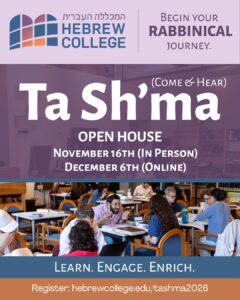 Meet students and faculty at one of our fall open houses, Ta Sh’ma (Come & Hear) November 16 (in-person) or online (Dec. 6).
Learn more and register.