

Alumni Alumni Spotlight:
Rabbi Shoshana Meira Friedman
We recently spoke to Hebrew College 2014 alumna Rabbi Shoshana Meira Friedman about her rabbinate and the unusual and exciting turn it has taken. Below are excerpts from that conversation.
Q. You’ve been very active in the neurodiversity movement on social media and recently even had an essay about PDA published in Psychotherapy Networker Magazine. Can you explain PDA to our readers who haven’t heard of it?
PDA is an emerging neurodivergent category that describes my son perfectly. It also, it turns out, describes me – and it may describe someone you love, too!
PDA stands for Pervasive Drive for Autonomy, or Pathological Demand Avoidance. Essentially, PDAers have highly sensitive autonomic threat responses that easily go into fight, flight, freeze, flop (shut-down) or fawn (people-pleasing out of fear) when faced with losses of autonomy, control, social equality, or co-regulation in daily life.
 My kiddo tends to go into fight, where I tend to freeze or people-please, but the idea is the same. Our bodies interpret a loss of autonomy, control, or social equality as threatening — it could be the need to eat, or leave the house, or answer a question, or any number of things – and our nervous systems go into an exhausting survival mode that can lead to what looks like misbehavior but is better understood as a panic response.
PDAers have many strengths. We are often great autodidacts, charismatic leaders, highly empathic when we feel safe, and very creative. But our threat response is disabling, and we are prone to debilitating burnouts. When a PDAer looks “demand avoidant,” it’s a physiological can’t, not a psychological won’t. What we need is to feel safe so our nervous system capacity can expand, and we can access what we need to thrive, including basic needs like eating and sleeping.
Many PDAers are Autistic, like me and my son, but we tend not to look like Autistic stereotypes. The nervous system lens is a big missing piece in supporting many struggling kids, teens, and adults.
Q. You have been a congregational rabbi in the past, but you’ve also had some unconventional rabbinic roles, like climate activist or director of the Artist Beit Midrash. What are you up to as you support PDAers?
After a deep self-study on Autism and PDA for the sake of myself and my son, I have been coaching PDA adults and parents of PDAers for the past year. And I just launched The PDA Safe Circle™ in February 2025!
Q. Can you tell us more about The PDA Safe Circle and how it is a kind of rabbinate?
Yes! The PDA Safe Circle™ is an online community of practice for PDAers and our family members — with a big tent. (You don’t need any clinical identification — if you think a PDA framework will support you or a loved one, you are welcome.)
 I like to think of us as a secular online congregation. At our center is my PDA Safe Circle™ Approach, which is a visual and intuitive approach that decreases distress and increases thriving for this vulnerable and misunderstood population.
Unlike a regular online course, you learn the Approach inside a supportive community of real people that you access through an app. It’s like the app is the synagogue building and the Approach is – if you’ll forgive the grandiosity – the core sacred text.
The funny thing about this rabbinate is that while it looks unconventional, it’s the most traditional rabbinate I have ever had. In my previous rabbinic roles I led services, ran programs, and organized for social justice. But I very rarely played pastor to anyone in need of answers to navigate their personal daily life.
By contrast, in The PDA Safe Circle, my “congregants” come to me for a kind of psak halacha. They have real, pressing issues in their lives and they need real answers and urgent guidance. Their kids can’t tolerate school anymore. They are struggling in their marriage or job. Their child’s or teen’s meltdowns are getting more intense. Their brilliant adult kid has a hidden nervous system disability and turns out they can’t make it on their own. The mental health professionals, education system, and medical world have made everything worse.
I bring my neurodiversity-affirming strategies, my intuition as an Autistic PDAer, and a robust nervous system lens on top of a bunch of specific tools. I am helping individuals and whole family systems get out of crisis and start to thrive where trained therapists failed. They failed because the therapists lacked the right halacha, shall we say, for PDA and Autistic brains and bodies.
I like to define Torah pretty broadly, and The PDA Safe Circle Approach draws on a lot of “Torah”: my chaplaincy training, Internal Family Systems, Polyvagal Theory, Nonviolent Communication, Design Thinking, Low Demand Parenting, evolutionary psychology, the new science on child development, as well as indigenous child-rearing wisdom, communal Autistic wisdom, and disability wisdom. It also draws from my experience in improvisational theater and child-centered hospital clowning. It’s counter-cultural and extremely healing for many — not just PDAers.
Q. I’m intrigued by the image of an app as a synagogue. Can you tell me more about The PDA Safe Circle as a community?
Because Western culture is so disabling to PDA nervous systems, many PDA adults and families are quite isolated. For example: my son is out of burnout now, but at his baseline level of disability he still rarely leaves the house. Even though he is seven, my husband and I are the only company he can tolerate for more than an hour or two at a time. So, our whole little family is fairly isolated. This is also the case for many of my clients. Even those who aren’t physically isolated often feel totally alone, battling educational and medical systems that don’t understand a nervous system approach.
With my experience as a community organizer and rabbi, it was a natural step to start The PDA Safe Circle to both teach the Approach and decrease isolation.
 I also wanted to create a space where PDA adults and parents could offer their own skills and expertise to others. I have members who are excited to teach crafting, and others who are experts in navigating the IEP process in public schools. Some folks are in crisis and need to just receive, and others are so happy to give and receive. That makes a community.
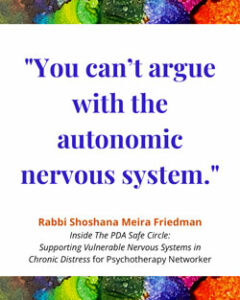
And the model is resonating. In just a month of being open to the public I have over 90 household members! (Above: Rabbi Shoshana posts regularly on Instagram where she has over 22K followers learning about PDA and neurodiversity.)
Q. How did your Hebrew College education help prepare you for this work?
Hebrew College taught me what it means to be a community of practice. There is a core set of texts and values at the center, and each person determines how to enact those texts and values in the context of their own life — with the support of others in the community. That is very much what I’m doing in The PDA Safe Circle, and I never would have had the intuitive sense of it without my education and community experience at Hebrew College. While I’m not using the Hebrew text skills in this rabbinate, I am certainly using the broader Torah skill set of a Hebrew College education. Torah — which I define as deep wisdom to live by — is an evolving, living thing. We don’t have to take the establishment’s interpretation as final. We can and must reinterpret. In the case of the neurodiversity movement, we are reinterpreting human experiences and nervous systems in light of what we know that older generations did not. Unlike many online teachers, I am also highly influenced by the havruta and group model of learning. I am not holding myself as the only expert in the room. Instead, my long term vision is to empower my members to have their own relationships with these tools and teachings, and to be peer “coaches” (i.e. havruta by another name) for each other as they navigate life.
Q. I hear you also have a children’s book out this spring! Can you tell us about it?
 I didn’t plan on launching a business and a book in the same few months, but here we are. The Tide Is Rising, So Are We!: A Climate Movement Anthem is a picture book in verse. It’s based on the song that my husband, Yotam Schachter and I wrote for the climate movement back in 2015. The Tide Is Rising anthem has a life of its own. It spread widely over the past decade, and has been sung at community gatherings, worship services, protests, marches, and blockades over three continents!
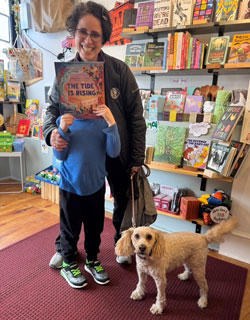 The picture book is an expanded version of the song. Unlike many climate books for kids, it doesn’t place the onus of action on the child’s shoulders. That message was very damaging to me as a child in the environmental movement of the 1990s. Instead, the book brings the reader into the collective story of the climate movement. It invites you to join this movement and bring your skills and love to it — but it also simply tells you that there is a movement, and that you are not alone in your pain or your love for the world. This is a very important message for children, and honestly all of us.
The book is published by Beaming Books, which is (hilariously for me!) a wonderful Lutheran press that puts out ecumenical kids’ books. I’ve loved working with them.
Q. Are there Jewish themes or content in The Tide Is Rising book?
While the book isn’t only for Jews, it resonates Jewishly to anyone in the know. I’m a character in the illustrations, so you see me in my tallit, playing guitar or ukulele. Several verses of the poem/song draw on Jewish texts, such as “The task is mighty. So are we!” which is based on Pirkei Avot, or “The land is holy. So are we!”
The entire framework of the book is that we are not only individuals. We are a people on a sacred collective journey in a covenant with each other and the Earth. That framework is of course inspired by Jewish mythos and ethos.
Q. Where can people buy The Tide Is Rising or check out The PDA Safe Circle?
The Tide Is Rising is available anywhere books are sold! I encourage you to order from my hosting local bookshop if you can. I’ll be doing a book launch and free concert in Roslindale, MA on Sunday April 27, 3-5pm, so you can come and buy in person there – while also enjoying some uplifting music in challenging times.
The PDA Safe Circle information is at PDASafeCircle.com. It has an equity-based membership fee structure, and no one is turned away for financial reasons. I would love to welcome any Hebrew College community members!
Learn more about Rabbi Shoshana Meira Friedman on her website rabbishoshana.com. Learn more about Hebrew College alumni here.
Explore Graduate Programs Professional Development Support Our Work