

Numbers What the Image Holds
Parashat Chukat-Balak (Numbers 19:1-22:1, 22:2-25:9)
Recently at Calder Gardens, a new museum in Philadelphia dedicated to the work of Alexander Calder, I noticed there were no curatorial blurbs. Typically, I let the curatorial remarks shape how I see a work of art. There’s something comforting about being told what I am looking at. The curator has expertise; they’ve done the research. Their words offer a kind of certainty. But sometimes I’m so absorbed in what they have to say that I forget to look at the piece itself, and I leave carrying someone else’s experience rather than my own.
At Calder Gardens, I didn’t have that option. I was invited into direct relationship with Calder’s sculptures, paintings, and mobiles. Without explanatory text to guide me, I could only make sense of the work through my own experience of it: watching the way the air currents moved it, feeling stirred by its creaturely presence, reflecting on what it reminded me of.
In Parashat Chukat the Israelites, too, are searching for something that will relieve the discomfort of uncertainty – searching for solid ground, for assurance God is with them and that they will survive the wilderness. This is not the first time they have struggled. Since entering the wilderness, the Israelites have longed for Egypt – for the predictability of slavery over the uncertainty of freedom. They have manna and water from Miriam’s well – miraculous, yes, but unpredictable, not what they would choose at the moment they wanted it, if they had the option. When things don’t go the way they desire, they complain over and over again.
Then comes a strange and unsettling turn. In response to their complaints, God sends fiery serpents that bite the people. Many die. They acknowledge they’ve done wrong and ask Moses to save them. God then tells Moses to make an image of the serpent that bit them and mount it on a pole, promising “anyone who was bitten who then looks at it shall recover” (Deut 21:8).
Moses sets aside words. He doesn’t pray to God, or lecture the people, or explain what he is doing and what it means. Words would get in the way. They’ve been used to complain, blame, justify, take sides. Perhaps they would offer a sense of certainty, but it would be temporary, a promise he couldn’t keep.
An image can hold what words cannot. The serpent can be read as making visible not only the literal pain of the snake bites, but the deeper emotional and spiritual suffering that had been accumulating in the wilderness: the longing, the fear, the uncertainty. In a moment of both personal and communal crisis, the image meets the people inside their own experience of suffering and then draws them toward something shared – something larger than their individual pain. There is something uniquely healing about seeing your private suffering made visible in a shared space – about knowing you are not alone in it, that others are standing alongside you, taking in the same sight, bringing their own thoughts, sensations, and stories to it.
The Hebrew here is illuminating: the verb the Torah uses to describe the way they are to look at this image is lehabit. This isn’t a casual glance. It means to behold, to consider, to give something your full and sustained attention. Not the quick work of words, but a slower, more embodied encounter with an image. They aren’t healed by being given the certainty they crave, by simply glimpsing the serpent and moving on. Rather, they are asked to pause. To be present to what it evokes for them. To dwell in the space between what happened and what comes next.
The people are not to escape what happened – the snake bites, the losses, the fear – or explain it, or fix it. They are to stay with it. To behold it. There is something in the act of pausing – really pausing, without rushing to explain or fix – that creates enough space between ourselves and our suffering to bear it. In that stillness, something shifts. We don’t need to solve what happened, or find the perfect response. We just need to be present to what is true for us in that moment. And sometimes being present is enough.
One of my favorite things about looking at art is the way it invites me to see the world differently. The stakes at Calder Gardens were not the stakes in the wilderness. No one was dying. But the invitation was the same. Leaving Calder Gardens without the neat handle of titles or explanations to carry with me, the experience stayed alive in me: I noticed how the light played with shadow, the sprays of color outside in the garden reflected on the outer wall of the museum like an endless horizon. Even the faucets in the bathroom danced through space in a wondrous way. I still had to go home and make lunch and do the dishes. But something had shifted. The ordinary was still ordinary. And for a moment, that was enough.
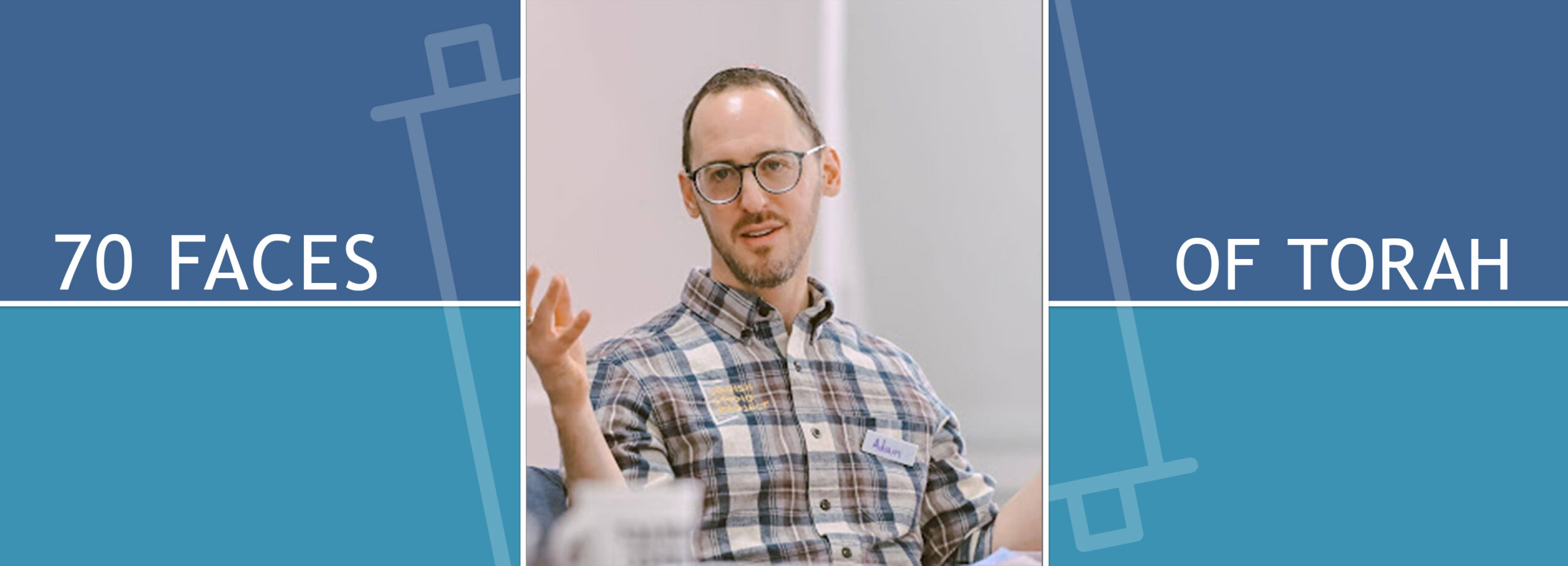
Rabbi Adam Lavitt (he/they) is a spiritual companion, educator, and facilitator committed to helping people access inner wisdom and explore what matters most. Drawing on experience in pastoral care, education, and chaplaincy, Adam creates transformative spaces where people can deepen their connection to themselves, each other, and Jewish tradition. Ordained at the Rabbinical School of Hebrew College, where he earned a Master’s in Jewish Education and the school’s first certificate in Pastoral Care, Adam is also trained as a spiritual director and a Board Certified Chaplain. He has served as a spiritual leader in congregations, college campuses, and healthcare settings, and is an alumnus of CLAL’s Rabbis Without Borders and JOIN for Justice’s Clergy Fellowship. Adam now works at the Jewish Studio Project, guiding educators, spiritual leaders, and seekers in integrating creativity and spirituality as pathways for growth and discovery.
Support Our Work Explore Graduate Programs Tamid Adult Learning Classes