

Rosh Hodesh Rosh Hodesh Shevat:
A Prayer for Faith and Action
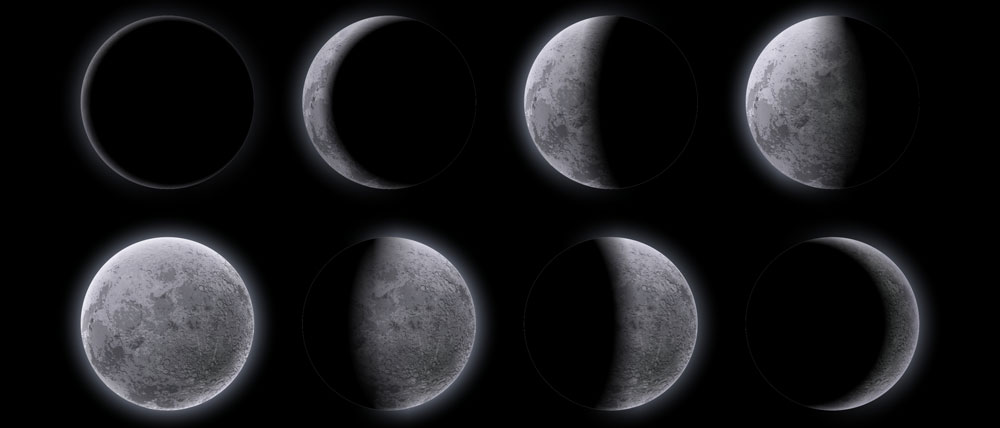
Our ancestors saw in the cycle of the moon insights about our experience of God.
The fullness of the moon, when it lights up the sky, came to represent the felt presence and redemptive experience of God in our lives. It is not an accident that some holidays, including Purim, Passover, and Sukkot, begin when the moon is full. The darkest of nights, when the moon has waned and is not visible, came to represent the experience of God’s hiddenness and distance from our lives. The moment of the moon’s emergence from darkness they marked as the beginning of the month and developed a practice of marking it each time it occurred in its cycle. They called it, evocatively, Rosh Hodesh, which means both ‘new month’ and the ‘beginning of renewal’.
Our ancestors’ custom of marking time by the cycle of the moon is an expression and practice of faith. It is based on a recognition that all experiences, whether dark or light, traverse a never-ending loop, one inevitably yielding to the other. By making the beginning of the cycle the moment of rebirth, just as the darkness is turning back towards light, they plant a flag on the side of faith and hope. They orient us towards the inevitability of renewal at the time we need it most. In the practice of Rosh Hodesh, we affirm and accept this eternal cycle of nearness and distance from God and cultivate faith and hope in God’s return. In this insight and ritual, I feel the loving accompaniment of our ancestors who knew we needed this ritual.
But faith alone in the natural cycle of waxing and waning, renewing and deteriorating, is often insufficient for a new beginning to occur in moments of darkness, when God is hidden from our lives. Maybe because of this, our ancestors did not only find faith, patience, and forbearance in the cycle of the moon. They also found a call to action that they expressed in stories.
One was about the Divine injustice of making the moon smaller than the sun since God had declared, as part of the creation process, that both were “great lights” (Genesis 1:16). They taught in the Talmud that we bring a “חַטָּאת לַהֹה,” “a sin offering for God” (Bemidbar 28:15) on Rosh Hodesh to atone for God’s treatment of the moon and to help bring about a tikun, a healing (Babylonian Talmud Hullin 60b).
Another imagined the Israelite women at Mount Sinai refusing to give their jewelry to their husbands to build the golden calf, calling the idol “a repulsive, idolatrous abomination without the power to save” (Pirkei DeRabbi Eliezer 45). For their refusal, God rewards them with particular responsibility for observing Rosh Hodesh.
In both these stories, and others, our ancestors’ make Rosh Hodesh a ritual of response, reminding us not just to wait for God’s return and a better world but to help bring it about.
As we approach the new month of Shevat, which begins Thursday, we are invited to contemplate and cultivate these opposite yet complimentary insights that our ancestors found in the symbolism of the moon and dark times: faith and action. For those of us who are minorities, these teachings and rituals are exceedingly timely. We are indeed entering dark times with a desperate need for faith and action. As a Jew, I can’t help but think of our own history of being demonized as vermin, parasites, and invaders, and the horrific times when that hatred was sanctioned by and/or coupled with state power. I feel deep concern for immigrants and transpeople who, with recent executive orders, are currently in the cross hairs of that dangerous combination and anxiety that Jews and other minorities may be next. I pray for the faith to endure until more compassionate, humane, and just times and for the wisdom to discern actions that help lead us there.
At the same time, I am aware that our country is deeply divided. Many feel we are descending into darkness while many among us feel we are emerging from darkness – from, ironically, a time of dehumanizing rhetoric and policies that undermine a way of life and the ability of some to succeed. While I don’t count myself among this group, I take seriously the perspectives shared, questions raised, and challenges offered, trying to listen with humility, respect, compassion, and curiosity. For me, I can say there is much to grapple with in the confusing realm of immigration policy, the changing sands of gender paradigms, and the complicated dynamics of class and race.
The Rosh Hodesh prayer on my heart for all of us in this country, however we understand the moment we are in, is to have and continue to cultivate faith in the presence of God in all people, especially when we find it most difficult to do so, and for our actions to be responsive to and energized by this faith.
כן יהי רצון
May it be God’s will.
 Rabbi Daniel Klein, Rab`10, MJED`10 is Dean of the Rabbinical School of Hebrew College in Newton, MA, where he formerly served as Dean of Students.