

Alumni What are you doing on Saturday?

When interviewing for a job with Kehilat Moriah in Haifa, I was asked what my biggest fear was when it came to becoming a rabbi.
My answer was particular to becoming a rabbi in Israel. What if something terrible happens? What if, on my first day of work, some great national calamity takes place? Will I know what to do? Will I be able to be there for people?
As it turned out, I would get an answer to both of these questions sooner than I thought. On my first day of work, war broke out between Israel and Iran, thrusting our country into a strange new security situation which was unlike any I had ever lived through before, despite having spent over a decade in Tel Aviv before rabbinical school.
As it turned out, just like I feared, I didn’t know what to do, but we improvised. Unable to host a Bar Mitzvah at the synagogue due to the lack of a proper shelter, we began making provisions to host it at the young man’s grandparents home with a smaller guest list. The community’s president and I wrapped up a sefer torah in tallitot and brought it over before Shabbat between sirens.
But what I learned my first week on the job was the simple truth that no matter what happens in this world, I always know the answer to the following question: what are you doing on Saturday?
Time has passed since that first Shabbat on the job. We’re no longer in a state of emergency. In fact, the situation has improved. The hostages are home and the war is—ostensibly—over. But a strange sense of unease remains.
Many of my congregants have come to me in the past month plagued by anxiety and uncertainty about the future of the Jewish people. The end of the war was supposed to bring relief, but somehow, with the state of emergency over, people are finding that other, more long-term concerns are felt with a new urgency.
On the one hand, there is the future of the Jewish state. Political strife, increasing polarization, and a strong rightward shift all contribute to this sense of unease. Beyond our borders, things seem just as upside-down as here as we watch antisemitism surge in every corner of the globe.
Of course, there is nothing I can say to alleviate these concerns. I do not know what our future holds. I don’t know where these trends will take us and in truth, I am just as frightened as anyone.
But what I learned my first week on the job was the simple truth that no matter what happens in this world, I always know the answer to the following question: what are you doing on Saturday?
We will gather, we will read the Torah, we will say kiddush. Outside the window, there will be times of war and times of peace, times of pandemic and times of health, times of protest and times of calm.
Inside, however, it will always be the same Torah, the same prayers, the same stubborn insistence on trying to find an island of peace and holiness in a week of chaos and confusion.
And there are some days when it seems that the island of peace extends beyond the walls of the synagogue.
When my partner Yoav and I walk home after prayers and see a wild boar grazing in the park, or wake in the night to the sound of a long prayed-for rain pouring down onto the parched land.
In these moments, we breathe in the beauty and blessing of this land, and remember that it is more than the sum of its crises, and we say baruch hashem.
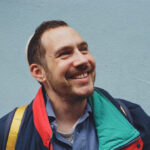 Rabbi Matthew Schultz was ordained by Hebrew College in 2025 and is rabbi at Kehilat Moriah in Haifa, the oldest running Conservative Synagogue in Israel. He is also a columnist with the LA Jewish Journal and author of the “Dispatches from the Promised Land” substack newsletter.
Matt is one of four Hebrew College alumni leaders serving communities in Israel. His fellow alumni include Rabbi Deborah Anstandig `25, educational director for Engagement at Pardes; Rabbi Minna Bromberg `10 , founder & president of Fat Torah; Rabbi Lila Veissid Rab`11, MAJS`1, regional rabbi at Emek Hefer; and Rabbi Shuki Zehavi `19, MAJS`19, rabbi at the Fuchsberg Jerusalem Center.