

Jewish learning “We Are Here”: Survivors’ Talmud Marks a Legacy of Learning
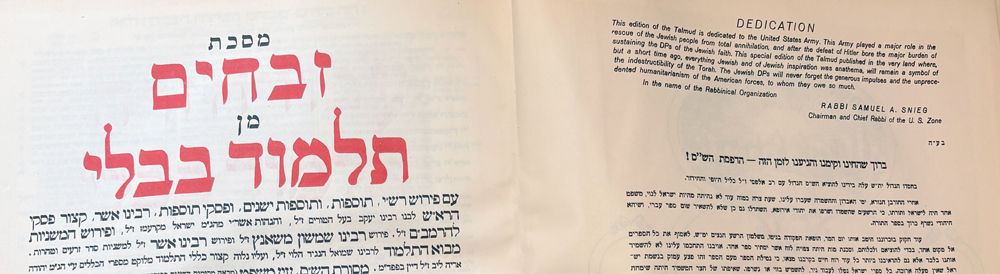
Next month on Yom HaShoah, Hebrew College will hold a dedication ceremony for a historic Talmud edition in honor of Rachel Jacoff, a scholar of Italian literature and beloved longtime participant in the College’s Tamid adult learning community who passed away in January of 2025.
The edition, printed in postwar Europe with the support of the American military in collaboration with the rabbinic leadership of the American-run displaced person camps, is known as the Survivors’ Talmud or U.S. Army Talmud. Published in Munich in 1949, these 19 volumes were intended as a practical resource for rebuilding Jewish learning, and a symbol of the enduring Yiddish declaration, “Mir zaynen do,” “We are here.” At Hebrew College, this historic edition has never been treated as a relic, but as a living text, studied and engaged as part of our vibrant, ongoing tradition. In this spirit, the dedication ceremony will honor Jacoff’s generosity, intellectual passion, and lasting contributions to the College, while reaffirming the Survivors’ Talmud’s legacy and the enduring power of Jewish learning.
 The story of the Survivors’ Talmud begins in the immediate aftermath of World War II, amidst the devastation of Jewish life in Europe. By 1946, when Jewish survivors in displaced person camps across Allied-occupied Germany were rebuilding their communities and their lives, no complete set of the Talmud could be found on the continent. Recognizing the need for intellectual and spiritual renewal grounded in our sacred texts, a group of rabbis, many themselves survivors, petitioned the U.S. Army to support the printing of a full edition of the Talmud. “Functionally, pragmatically, and symbolically, it said, ‘We are here, and our great tradition is alive and well and flourishing,'” says Hebrew College Professor Rabbi Nehemia Polen. With the backing of military leadership and the guidance of chaplain rabbis in collaboration with the American Jewish Joint Distribution Committee, this extraordinary project took shape.
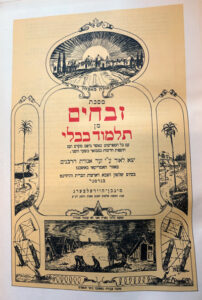
Printed in 1949 and 1950 in Heidelberg at a former Nazi printing plant, the Survivors’ Talmud is the only known edition of the Talmud ever produced by a government body. Approximately 500 sets were printed. However, by the time the project reached fruition most survivors’ had emigrated from Europe. Forty sets were allotted to universities in Germany and the rest were distributed to Jewish communities and institutions around the world. Each of its 19 volumes bears a striking title page: an image of a barbed-wire camp below, juxtaposed with scenes of palm trees and religious-artistic representations of Eretz Yisrael above, alongside Hebrew words that translate, “From bondage to freedom, from darkness to a great light.”
Hebrew College’s own set is part of this remarkable history. While many institutions have placed their copies in rare book collections, the volumes here have long remained in active use. Former library director Dr. Maurice Tuchman insisted that the set should not be a museum piece but remain a text to be opened and studied. That commitment continues today. “I don’t think there was much of a question. I can’t imagine there was a discussion about putting it behind glass. That wasn’t the point,” says Hebrew College Provost Rabbi Dan Judson. “Its creation was an attempt to engender and further the study, the classic study of Talmud, even in the displaced persons camps, for those who wanted it, and by distributing it to other institutions like Hebrew College, clearly it was meant to say that despite the horizon of trauma, we continue to study.”
It was our honor to have [Rachel Jacoff] in our classes…elevating the discourse, elevating the wisdom level.
— Rabbi Nehemia Polen
The upcoming dedication ceremony will also honor the memory of Rachel Jacoff, a Professor of Comparative Literature and Italian Studies at Wellesley College from 1977-2010, and a devoted participant in Hebrew College’s adult learning community. As Rabbi Polen recalls, she was “Passionate about learning, passionate about listening, passionate about transmitting the joy of learning to the younger generation.” Her involvement included formal courses and morning text studies, where her presence enriched the learning environment. Says Rabbi Polen: “It was our honor to have her in our classes…elevating the discourse, elevating the wisdom level.” By joining Rachel Jacoff’s legacy to this historic text, Hebrew College affirms our gratitude for the resilient commitment of our ancestors, whom we honor by sustaining and evolving Jewish life through expansive study.
After the ceremony, the Talmud will be set in a more permanent and dignified display in the Mascott Beit Midrash, where, like so many other editions pored over each day, it will remain available as a study and reference text for rabbinical students and other learners. May the Survivors’ Talmud, born in devastation and reaching toward renewal, remind us that learning is not only an intellectual pursuit but also a personal and collective act of resilience and hope.