

Podcast Ep #29: Reclaiming Female Presence

I really believe that our job as readers here is to notice those ways in which [Bavli Sotah] is pushing back against the ritual, because that noticing also then enables us to take those next steps of continuing to push back against what might be brutal in our society and form another ethic.
– Rabbi Jane Kanarek, PhD
What happens when we begin reading the Talmud with an assumption of female presence rather than female absence? In this episode of Speaking Torah, Rabbi Dr. Jane Kanarek, Professor of Rabbinics and Dean of Faculty at Hebrew College, joins her longtime havruta partner Dr. Judith Kates to explore Jane’s book Beyond Brutality: Reclaiming Female Presence in the Bavli Sotah.
Focusing on Tractate Sotah, a text shaped by a brutal ritual that publicly humiliates women, Jane demonstrates how reading the tractate as a unified literary whole reveals something surprising: the Bavli itself pushes back against that brutality.
Tune in today to reflect on how feminist scholarship can uncover unexpected voices, ethical commitments, and literary coherence within one of the Talmud’s most troubling tractates.
What You’ll Discover from this Episode:
- Why reading a Talmudic tractate as a whole literary unit reveals thematic arcs that would otherwise be missed
- How Bavli Sotah positions King David as a Sotah figure while elevating Tamar as righteous and learned in Torah
- The way the Midrash of the righteous women in Egypt subverts the Sotah ritual through an ethic of care
- Why assuming female presence rather than absence transforms what we can see in Rabbinic texts
- How the Talmud itself pushes back against the brutality of the Mishnaic Sotah ritual
- The connection between the eglah arufah (decapitated heifer) ritual and caring for strangers
- What it means for Torah to be both sam ha-hayyim (elixir of life) and sam ha-mavet (poison of death), and our responsibility to make it life-giving
Featured on this Episode:
 Rabbi Dr. Jane Kanarek is Professor of Rabbinics and Dean of Faculty at the Hebrew College Rabbinical School. She is the author of Biblical Narrative and the Formation of Rabbinic Law and the co-editor of Learning to Read Talmud: What It Looks Like and How it Happens and Mothers in the Jewish Cultural Imagination, the latter two of which were finalists for the National Jewish Book Awards. In fall 2025 her book Beyond Brutality: Reclaiming Female Presence in Bavli Sotah was published by Brandeis University Press. She was ordained by the Jewish Theological Seminary and holds a PhD from the University of Chicago.
 Dr. Judith Kates, retired Professor of Jewish Women’s Studies at Hebrew College, was a founding faculty member of the Rabbinical School, where she created core text courses on Torah as understood within the full range of Jewish interpretation.
She has taught Tanakh and Rabbinic texts in many settings of adult learning in the Jewish community.
She co-edited (with Gail Twersky Reimer) two pioneering collections of contemporary feminist Bible commentary: Reading Ruth: Contemporary Women Reclaim a Sacred Story and Beginning Anew: A Woman’s Companion to the High Holy Days. In 2017 Hebrew College awarded her an honorary doctorate.
 Rabbi Jessica Lowenthal `19 (Host) is the spiritual leader and Education Director at Temple Beth Shalom in Melrose, MA. She was ordained in 2019 at Hebrew College. Before attending rabbinical school, Rabbi Jessica was Assistant Regional Director at the Anti-Defamation League in Boston, working with partners like MIRA (Massachusetts Immigrant and Refugee Advocacy Coalition) and MassEquality. She holds an MBA in non-profit management and MA in Jewish Leadership from the Hornstein program at Brandeis University and a BA from George Washington University in Religion and Judaic Studies.
A special thank you for this episode’s musical contributions:
 Intro by: Rabbi Jackson Mercer `23
Jackson is the Base Rabbi for Boston. Collaboration and creativity are at the core of his desire to cultivate meaningful Jewish experiences. Through his work, Jackson built singing prayer communities across the country in California, New York, and Boston. He also founded and built a Judaica brand, Hiddur Mitzvah, with his partner and fellow artist Rachel Jackson and sings with R’ Josh Warshawsky in the Chaverai Nevarech Band.
Esa Einai (Psalm 121:1)
Music by Jackson Mercer
Guitar and Melody by Jackson Mercer
Harmonies by Cantor Rosalie Will, Ilana Sandberg, Rabbi Micah Shapiro, Rabbi Josh Warshawsky, Noah Diamondstein, Ryan Leszner, Eliana Light.
Ribon kol ha’olamimWritten and performed by Marni Loffman from the album The Long Short Path.
Book cover
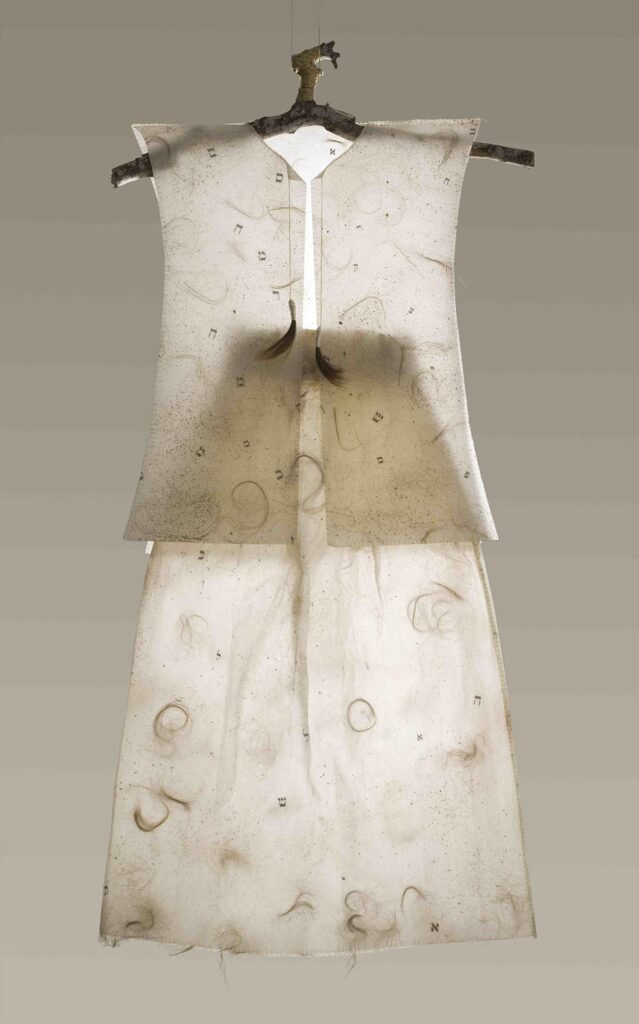 “The Dress of the Unfaithful Wife” (2009) by Israeli artist Andi Arnovitz
Japanese paper, hair, dirt, film, and threads
110 x 46 x 13 cm
“The Dress of the Sotah,” which literally means the adulteress wife, addresses the painful ordeal depicted in the Bible in which a man who suspects his wife of committing adultery brings her before the high priests and forces her to publicly uncover her hair and drink a bitter water to prove her innocence. The piece refers to her lack of privacy, the public humiliation and her sexuality which so troubled the Rabbis.
Full Episode Transcript:

Jessica: Welcome to Speaking Torah. I’m your host, Rabbi Jessica Lowenthal, spiritual leader of Temple Beth Shalom in Melrose, Massachusetts and 2019 graduate of Hebrew College.
In this podcast, Jewish leaders from around the world, Hebrew College faculty, alumni, and students discuss how Torah can help us navigate the most pressing issues of our time. Together, we explore the ways Torah can help us approach the world with creativity, healing, and hope.
We are excited to offer another new episode focusing on this season’s theme of new Jewish literature.
This week, we are invited into a conversation with Rabbi Dr. Jane Kanarek, Hebrew College Professor of Rabbinics and Dean of Faculty, about her new book, Beyond Brutality: Reclaiming Female Presence in the Bavli Sotah, with her longtime friend and havruta study partner, Dr. Judith Kates, retired professor of Women’s Studies at Hebrew College.
In her book, Jane draws on feminist analysis and gender studies to examine Tractate Sotah of the Babylonian Talmud as a literary unit and to make it accessible to not just Torah scholars, but to all audiences. By interrogating how, why, and where women are invisible within the Bavli Sotah, she brings to light a ubiquitous female presence throughout the text. Despite the brutality of the Sotah ritual, in which the woman accused of adultery is put through a divine ordeal intended to reveal her innocence or her guilt, her book demonstrates that Bavli Sotah is not primarily concerned with describing the Sotah ritual or establishing male control over women. Let’s listen together.
Judith: Jane, this is such a pleasure for me to be able to talk with you about this really extraordinary book, which represents untold amounts of work on your part. And there are many ways in which it’s so impressive that you’ve been able to do it and that you’ve done it in the way you did. And what I really want to begin by talking about a little bit is this is a book that really participates in a kind of scholarship that is relatively new in the Jewish world. And I’m talking about very serious and learned scholarship about the Talmud, the Babylonian Talmud, written by women, representing a whole community of women who have become major Talmud scholars. And your book participates in that community and represents a part of what makes that community so outstanding because women who are Talmud scholars are starting to write about the Babylonian Talmud in ways that really reflect who they are, as well as reflecting their deep immersion in this tradition of Talmud scholarship, which has existed for over a thousand years.
I want to register that, but also that your book in particular, and I have to say that I’m not a Talmudist, as you know, what I’ve always taught has been Tanakh, Midrash, other kinds of Rabbinic texts, but not really Talmud. And for me, reading this book was extraordinary because you’ve written it in a way that really invites the reader in, filled with internal guidance, signposts that help us to understand why you’re talking about what you’re talking about, what you’re really focusing on, what we really should be trying to learn from the delve, the deep delve into the text of the Talmud itself. And I know that you’ve been actually very self-conscious about trying to write in a way that would enable people who are not necessarily such experts in Talmud to really learn from what you’ve written here. And anyone who just takes a brief glance at the footnotes will be aware of how much, how broad, how deep your delve into Talmud scholarship written by others has been. But I just want to register that there’s a way that anyone really can learn from this book. I want to just invite you to tell us a little bit about how you were thinking about the readership for this book as you were writing.
Jane: Thanks so much, Judith. I actually first want to just start by saying how honored I am to be in conversation with you about this book. This book grew out of our havruta together, our many years of learning Talmud together, and your real desire to learn this tractate of Talmud, to learn Bavli Sotah. And as you know, I resisted for many years. I said, no, no, it’s going to be too brutal and too troubling for us to study. And then I’d picked a number of tractates, and you humored me along until I finally said to you, okay, Judith, I’m ready. Let’s do Sotah. And so had you not been so insistent for so many years that we study this tractate, this book probably would not have emerged. And so I really want to name that as you’ve been crucial in this whole project.
And also just crucial to me as a model of what it means both to do feminist scholarship, feminist teaching, and then try and live to the best of your ability a feminist life. So you’ve been just a role model and a mentor and a study partner and a friend to me for so many years, and so it’s just really a deep honor to be in conversation with you.
The name of my book is Beyond Brutality: Reclaiming Female Presence in Bavli Sotah. When I was writing this book, I very much wanted to write a book that was speaking to the world of Talmud scholarship as well and integrating that and a scholarly rigorous book, but my other commitment was really to write this book to an audience that is interested in Talmud, that might want to study Talmud, that could study this book perhaps through a synagogue context or some context of adult learning. I also hope that it might be accessible to people who are interested in feminist studies in general, might be of use in a university humanities course, for example. So while I very much wanted this to be written to Talmudists and people who knew Talmudic scholarship and to move that world of Talmudic scholarship a step further, I also wanted it to speak to a broader audience, and that helped shape my choice not to write it in complete insider language.
Judith: Can you say a little bit about why you were so reluctant, a little bit more about why you were so reluctant, and really in particular why you’re using this quite serious word, brutality, about this part of the Torah?
Jane: I was deeply reluctant to take on this topic really because of the Sotah ritual itself, and I’ll talk about that in a moment, and even more particularly the Mishna’s version of the Sotah ritual. The Sotah ritual in the Bible is a deeply troubling patriarchal ritual where a man who feels this emotion of kina, probably jealousy/anger, but let’s call it jealousy, can subject his wife to a ritual in which she is brought to the desert tabernacle and made to drink some sort of potion mixed with this erasure of the verses of the Sotah ritual and some dust from the Tabernacle’s floor and some water. And she’s made to drink that potion, and if she is innocent, nothing happens to her body except that she can then become pregnant and bear seed. But if she’s guilty, her belly distends and her thigh falls, and that’s often understood as either miscarriage or uterine prolapse. And this ritual can be carried out regardless of whether or not there is actually any proof that she has in fact had sex with another man besides her husband. It can be done simply through his jealousy, he can instigate this ritual.
So what I like to say is the ritual from the Bible, from the Torah, it’s found in the book of Numbers, is bad, but it’s not atrocious. There is a very strong possibility of her innocence. It’s a ritual that’s done in private between husband, priest, and accused wife at the Tabernacle. It’s not a public ritual and there’s a very deep possibility of her innocence. So I like to say bad ritual, but not atrocious.
What happens in the Mishna though, and I’m going to use some words which are difficult, but I’m using them intentionally, they’re also used by two important scholars of the Sotah ritual, Sarra Lev and Yishai Rosen-Zvi, is that the ritual becomes this voyeuristic pornographic ritual. And what the Mishna does is imagine a whole ritual that happens before the ritual that’s described in the Torah. And what is spurred by jealousy in the Torah with a presumption of innocence or guilt becomes a ritual where guilt is really what is imagined for this woman. And in order to try and get her to confess, the Mishna actually has her brought up to the temple and then put on display before anyone who would like to see her, and women in particular are incentivized to come to see her. And her clothes are torn, and her breasts are bared before the public, and some sort of rope is tied to her breast. So she is degraded and humiliated publicly, and all of this is actually before the Sotah ritual itself has occurred.
And so what is in the Torah, a bad ritual, becomes a pretty horrifying and brutal ritual in the Mishna itself. And so because of the version of that of the Mishna, I really hesitated. I said I don’t need to go into the heart of Rabbinic misogyny, and I need to stay away from this tractate. But what I did know, and what Judith felt strongly about, is that there is also a lot of really stunningly beautiful narrative of Midrash in this tractate as well about some both named and unnamed women, including a whole long section that retells the story of the Exodus, including the roles of Miriam and Yocheved and the midwives. And it’s quite stunning Midrash.
So my title came from my desire to recognize and name the brutality of the Sotah ritual as imagined by the ancient rabbis, not to hide from it because I think that’s crucial, but at the same time not to stop there and to try and imagine what happens if we can move beyond that brutality. And in many ways, that’s part of what I think is happening in Bavli Sotah, in this Talmudic tractate, is it is trying to cope with the brutality of the Mishnaic ritual. So that’s part one.
And part two is the subtitle, Reclaiming Female Presence in Bavli Sotah. It might sound quite strange because the Sotah ritual does center women, and the tractate is filled with all of these stories about women to say that I’m trying to reclaim female presence. But that is what I’m trying to do. There is a paradoxical principle, which if you want, Judith, we can talk about more, where the Sotah herself both disappears in the tractate, and then all of these remarkable women reappear. So I wanted to say that female presence is here in the tractate, but in a different way than one might expect if one just thought about the Sotah ritual.
Judith: I really want us to come back to that point, which is absolutely crucial and runs throughout the book. But what I really would like us to start with is this quite interesting little story that you chose to begin with, which is really not about the Sotah ritual or anything that has to do with relationships, but well, it has to do with relationships between husbands and wives, but not anything that it would seem to be connected to the main subject of the of the tractate. I wonder if you would actually read us that story and tell us something about what that story is actually illustrating for you.
Jane: I’d be happy to. The book starts with this story. It’s from, for those of you are interested in page numbers of the Talmud, 40a. And this is the version that you’d find in our printed Talmud, not in manuscript versions of the Talmud. And said Rabbi Abbahu, at first, I would say that I was humble. When I saw Rabbi Abba from Ako, who said one reason and his speaker said one reason, and he was not angry, I said, I am not humble. And what was the humility of Rabbi Abbahu? That the wife of Rabbi Abbahu’s speaker said to the wife of Rabbi Abbahu, behold, ours does not need yours, and that he bends down and stands up before him is merely to do him honor. His wife went and told Rabbi Abbahu. He said to her, what do you derive from her? Through me and through him, the Most High will be praised.
The story is complicated. If you want to read an exposition of it, you can read it in my book, or you can actually read another version of it in a shorter piece I wrote for Sources, a magazine put out by Hartman. But in short, what happens in this story is we have a sage, Rabbi Abbahu, who says, I was humble. And then he says, oh, but there’s this other sage, Rabbi Abba from Ako, who is even more humble than I am. And then the Talmud goes on to ask about what was the humility of Rabbi Abbahu, this first sage. And the humility that it describes is that, I’ll give a little bit of background here, in the academies, sometimes a sage would have another person called a speaker who would repeat his words so that it could be heard by everyone else.
So the wife of Rabbi Abbahu’s speaker says to the wife of Rabbi Abbahu, basically, the speaker doesn’t really need you, the sage. When the speaker is talking, he’s actually saying his own words. He’s actually giving forth his own ideas to the assembled students. And he’s just bending down and standing up to pretend to honor Rabbi Abbahu and to pretend that he’s conveying his words. So then Rabbi Abbahu’s wife goes and tells her husband what the speaker’s wife said. And then Rabbi Abbahu speaks back to her and says, what do you derive? Don’t worry about it. It doesn’t really matter whose words are said. Regardless of whether it’s my words or the speaker’s words, those are actually going to praise God.
So I love this story because it portrays two women in conversation with each other. They’re actually arguing about Torah. One of the wives may have been present when the speaker is speaking, and they’re both actually concerned about who gets their due. And one could even say here that it is two women who are perhaps jealous and competing over Torah. That is a real counterpoint to the man who is jealous about his wife, about whether or not she might have had sex with another man. So here in the heart of Bavli Sotah, we have two women who are talking about Torah, who are perhaps jealous, who are in relationship with one another, and who are arguing about who gets credit for particular ideas.
Beginning with this story for me was about two central points of the book. One is this story comes in one of the sections of the tractate that actually has nothing to do with the Sotah ritual at all. It’s in the seventh chapter of the tractate. And part of the project of this book was to read the tractate as a whole, to not only read the parts about the Sotah ritual, but to read the entire tractate, to read it as a literary arc, as if it were a book with a throughline and a theme that goes all the way through it, and to ask what happens if I read this tractate as a tractate and don’t only read it about the Sotah ritual. So that was part one of saying, wait a minute, these women are actually a counter voice to the Sotah ritual, but they’re not in the sections of the tractate about the Sotah ritual. And then the second was to actually surface females and through that surfacing to ask the question of where, when, and how might females have been disappeared or disappear in this tractate, and what happens if we surface them and surface them as well as central to the project of creating Rabbinic culture and Rabbinic Torah?
Judith: I think this is something that I really would like us to talk a little bit more about, which is the fact that you took as part of your the main point of writing this book to actually try to understand a Talmudic tractate as a literary unit. It’s actually not the usual practice among Talmud scholars, and it’s a very complicated project to take on. But I’m hoping that we’ll be able to talk about this in a little bit more detail. But again, if you could just at the outset say something about why it was so important to you to actually understand the tractate as a whole and to find ways to explain to the people who are reading your book how it works as a literary unit.
Jane: To answer that, I want to start with another feminist commitment of mine, which is to acknowledge other scholarship as well. There are two wonderful books, one by Mira Wasserman on Tractate Avodah Zarah of the Babylonian Talmud, where she looks at it as a literary unit. And then there’s another book by Marjorie Lehman on Bavli Yoma, where she also looks at it as a literary unit. So I want to note some of the scholarship that I was leaning on as I wrote this book. And the other thing that I want to note is Tal Ilan’s project on feminist writing, a feminist commentary on the Babylonian Talmud, which is not looking for thematic arcs through the tractate, but is actually trying to look at, read whole tractates piece by piece. So I had these in my head.
But I think for this particular one, I really became interested in the question of what happens when we don’t just stop with the Sotah unit. The Talmud has been transmitted to us in the form of tractates. It has a shape of these individual literary units within a larger whole. And so internal to the tract to the Talmud itself, it also makes sense to look at a tractate as a unit and to see what shifts in how I might both understand the Babylonian Talmud writ large as a work and then the smaller unit within it and then the topic that I’m introduced about when I don’t just stop with the material that is most overtly about the topic, but actually look to a whole tractate that’s been named after the topic.
For Talmudists, I want to say that I do believe that there are probably a number of tractates in the Babylonian Talmud where you can trace a thematic arc through the whole tractate. I also think there are other tractates where you cannot, where they are assembled much more piecemeal and there isn’t the same throughline. But I really am convinced that Bavli Sotah is one of those tractates with a real thematic throughline to it. And I think you miss what’s happening with the Sotah ritual if you just read the parts about the Sotah ritual.
Judith: I think it would be helpful to just raise up one of the examples of some things that happen because of the way that you’re choosing to think about the whole tractate and the sense that you have of thematic arcs that emerge from that holistic approach. So what I really wanted to actually invite you to talk to us about a little bit more is one piece that emerges for you that really surprised me, which is a section of the Talmud in which focuses on some of the story of David, King David. And in which you tell us that David becomes a Sotah. And actually in a quite fascinating way, you juxtapose that with the story about Tamar and Yehuda and Judah where Tamar in that story in chapter 38 of Genesis, could in fact be described as a Sotah. That language isn’t used in the book of Genesis, but as soon as you say that, of course, it makes sense that she’s a woman who was actually accused of adultery unfairly. And what you say is that David is the Sotah and Tamar in this tractate emerges in a very different way, not as a Sotah at all. So I wonder if you would unfold that for us a little bit and perhaps read a little bit to us from the part of it, it’s on page 58 in the book, but perhaps set us up to understand what you’re saying as you talk about these two characters together.
Jane: Yes, it was one of the totally fascinating aspects of studying this tractate. In this tractate of Talmud, you would expect to see examples of women, actual women or biblical characters who are imagined as the Sotah. This does not happen at all in this tractate. Instead, King David is imagined as the Sotah. I’ll say a little bit more about that in a moment. And Tamar is actually imagined as hyper-righteous and knowledgeable of Torah. So what happens with King David? It’s pretty fascinating. The Mishna says that merit delays punishment. And what the Talmud debates is the question of what merit exactly delays punishment for the Sotah. Is it the merit of the performance of commandments or it is the merit of Torah study? That’s some of the larger context.
So in this section, David emerges as a male version of the Sotah. And this is how it happens. Basically, there are two characters, Doeg and Ahithophel, who want to assassinate him. And the Bavli says that the reason they thought they could succeed in killing him was because he had sinned sexually. He’d sinned with Bathsheba. And because he had sinned in this way, they had thought he would not be protected by God any longer, and they’d be able to successfully assassinate him. And what they actually didn’t know is that Torah study would protect David. So the fact that he studied Torah meant that Doeg and Ahitophel would not be able to assassinate him.
In other words, when the Bavli is debating whether or not Torah study is going to protect the sinning Sotah, they then, the character that they have that debate about is King David. So it is King David who sins sexually and would have died were it not for the fact that he had studied Torah. And in contrast, Tamar is figured as righteous and knowledgeable of Torah.
Judith, if you want, I’m happy to read a paragraph. It’s page 58. Through the use of a verse that mentions sexual prohibitions, Bavli Sotah hints at David’s guilt of the sin of sexual intercourse with a married woman, in this case Bathsheba. David’s sin thus overlaps with that of the Sotah, albeit with a reversal of gendered culpability. Much as the merit of Torah study protects the guilty Sotah, suspending her punishment, the merit of Torah study protects David from Doeg and Ahithophel’s attempt to kill him. Following the threat of David as the Sotah, we may also conceptualize the death of David and Bathsheba’s baby as parallel to the Sotah’s miscarriage and David’s bodily deterioration at the end of his life as a form of suspended punishment. This framing of the male biblical character of David as a Sotah is not solely an act of gender reversal or appropriation of the female for the male. It is part of Bavli Sotah’s larger project of shifting sinfulness to males. In contrast to the example of David as a Sotah, Bavli Sotah does not name or position specific females as potential Sotahs, even in cases when it might have done so.
To provide one example, the biblical story of Tamar, Genesis 38, depicts Tamar’s seduction of her father-in-law, Yehuda, when he fails to properly follow the laws of levirate marriage. Although Genesis 38:26 does proclaim Tamar’s righteousness, Yehuda declares she is more righteous than I, it would not have been outside the realm of Bavli Sotah’s Midrashic imagination for it to condemn Tamar for her ruse. Yet Bavli Sotah not only depicts Tamar as free of guilt for seducing her father-in-law Yehuda, but enhances her righteousness. Much as Bavli Sotah renders David as a Sotah, it presents Tamar as possessing some of the characteristics that it elsewhere associates with the ideal male Rabbinic Jew. Tamar follows after the patriarch Abraham, sitting at the place where Abraham once pitched his tent, utilizes halakha to seduce Yehuda, making a number of legal claims about her personal status, models modesty by covering her face in her father-in-law’s house, as a result she merits that prophets and kings descend from her, and warrants angelic interference in her fate. Gabriel steps in to ensure that signs she gave to Yehuda are recognized.
Judith: This is just a spectacular example of, first of all, this really remark remarkable reading of the tractate, but also the way in which you really are writing so as to open this up for us and also open up by giving us a concrete example, the point that you are making about a sort of thematic throughline that you’re finding within the tractate, what you do end up suggesting at various points through the book is that we have an arc that starts in the beginning with this shifting of sinfulness from the woman and in fact to male sinfulness. And that there’s then a closing where you actually at the end of your book, you reverse that. You give us the first chapter of Bavli Sotah in the end of your book. And then what you then bring to the surface is what’s in the middle, where you have this idea of male learning as part of the arc that we follow, which can be seen to erase women in the opening and the closing of the tractate, but the middle, in fact, as you put it, resurfaces women and what you were presenting just now is an example of that, where the figure of Tamar becomes an example of a real Rabbinic Torah scholar.
What I want in the interest of time to do is to actually follow up by asking you why you chose to postpone discussing the first chapter of Bavli Sotah until the end of your book.
Jane: Great question. I’m going to be precise here, which is I did discuss the opening of the first chapter early on in the first chapter, but it is the Midrash of the righteous women for whose sake Israel was redeemed that I held off discussing until the end of the book. And just a little bit about that Midrash. So it is a Midrash which tells the story about these unnamed women that go down to the field and they feed their husbands and they feed their husbands fish and water, and they have sex there and miraculously get pregnant.
Judith: We’re talking about during the period of slavery in Egypt.
Jane: Yes. Thank you. During the period of slavery in Egypt. So really countered a Pharaoh’s decree, they go down to the fields. And the women become pregnant, and they give birth under the apple tree, and the ground swallows them and their babies or just their babies up. The Egyptians plow over them. I actually left out a really important part. God acts as a midwife to these women as they’re giving birth, smoothing the baby’s limbs. And then they’re covered over by the earth, swallowed by the earth, the Egyptians plow over their backs. And then these babies or babies and their mothers are miraculously reborn. And later when they are after they cross the Reed Sea and sing the song at the sea, which includes the line, zeh eli v’anveihu, this is my God, God and I will praise him. The Midrash reads these babies as the first ones to recognize God, to actually point to God, zeh eli, this, this one that I see as my God, I know this God because I saw this God in Egypt. God was my midwife is the unsaid but understood comment there. And it is because of these women who went down to the field, according to Bavli Sotah, that Israel merited to be freed from Egypt.
It’s an absolutely remarkable Midrash on its own. It’s often read as Midrash of rebellion against Pharaoh. And what I wanted to do was read this Midrash in the context of the entire tractate, not only as a Midrash on its own, which is a wonderful thing to do to read it that way, but to say what happens when I actually notice that this Midrash is in Bavli Sotah, because if you have a tractate that’s ostensibly about the Sotah ritual and women accused of adultery, you wouldn’t necessarily expect to see in there a Midrash saying it was for women’s sake that Egypt was redeemed.
This was actually one of the hardest parts to figure out where I wanted to put it in the book. I knew I wanted it in the book. I knew it had to go in the book, but I really struggled where to put it. And as I kept working on the tractate and working on the book, I realized two things. One was that this was really a story not only about rebellion, but also about subverting the Sotah ritual itself. In other words, I could have read this story just as saying, well, they’re righteous women, these women who saved Israel, and they’re bad women, the Sotah. But what if it was actually more complex and the two were in conversation with each other?
So my first noticing was that there were a lot of ways in which this Midrash acted as a mirror to the Sotah ritual. A lot of details that were in it that were really mirrors to what was supposed to happen in the Sotah ritual and other moments in the tractate. And that’s when I started to realize that I could read this Midrash as subverting the Sotah ritual itself. It wasn’t just rebellion, but it was a counter voice, subverting the ritual, and offering other possibilities. But the other thing that I realized was this was also a story of care and profound care. And I realized that there were also themes of care running throughout the entire tractate of caring for strangers, of feeding the crucial point of being willing to feed a stranger, being willing to walk with, escort the stranger in a foreign place.
And so this story was a counter voice to the Sotah ritual, not only in these women subverting the ritual through the ways in which they had sex, the way in which they rebelled against Pharaoh’s decrees, but also in the care that they took for their husbands and for their babies. But then also in God coming and caring for these women and their babies. And so I wanted it at the end as a way of talking about possibilities for moving beyond brutality, and saying that even when we recognize brutality, this is a story that is happening in the midst of the brutality of Egyptian slavery, and nevertheless, there is are these radical moments of care there. So I wanted this book also to point us theologically to other possibilities beyond, to echo the title, beyond brutality, but to also point us towards care as well. And I really think that it is this complex interweaving of brutality and expanding circles of care that emerged throughout the tractate, that reading the tractate as a whole enables us to see the ways in which brutality and care are interwoven, but also not to stop with brutality, but to actually move beyond it to a very different ethic of care.
Judith: This is something that’s actually profoundly gratifying about seeing this emerge as you talk about the tractate. You in fact offer us this possibility, which is feels so important in the times in which we are now living, the idea of being able to hold together what is deeply troubling and at the same time seeing that when you’re thinking about this literary unit of the tractate of Bavli Sotah, that at the same time as there is all of this troubling material, there is also a development of this notion of care in many, many ways. It’s really interest it was interesting to me that as you point out, this Midrash about the righteous women is emerging almost within the same section as the discussion of the eglah arufah, which you were referring to that when you talked about caring for the stranger by accompanying the stranger who is out in perhaps in dangerous a dangerous place. So I wonder if you just fill that out for us a little bit because the righteous women and the eglah and I don’t know I’m not exactly sure how you translate eglah arufah into English.
Jane: How did I do it in the book? The heifer whose neck is decapitated, something like that. I think that’s how I did it. So it’s a ritual that’s done when a corpse is found in an uninhabited area and the murderer is not known. So there’s a whole special ritual. You take, you measure to the nearest town, and the elders from that town come bring a heifer and they decapitate the heifer in a wadi and the heifer somehow atones for this corpse where the murderer is not identified. And as part of this discussion, what the Bavli asks is, well, why does this happen? Why do we have this instance of a corpse who’s been murdered, and we don’t know who the murderer is. And the answer is that this occurs because the elders of the town turned away from someone who came and needed food, or the elders of the town turned away from someone who came and needed escort, presumably out of the town or to a different place. And because of these sins of turning away from what I call acts of care, that is why murders happen and that is why we need to do this ritual of the decapitated heifer.
So this is right there in Bavli Sotah and really talking in that section about the necessity of an ethic of care in order for society to function properly. There are a couple of what I like to call Talmud’s greatest hits in certain very limited circles. So in that chapter is also one of the Talmudic stories about how Jesus becomes a heretic. And one of the actual good figures in that story is a female innkeeper. So the rabbis in that story basically mess up. Jesus’s teacher is framed as messing up, not accepting Jesus’s repentance when he should have. But it’s the innkeeper, the female innkeeper, who actually feeds the travelers, feeds the group of sages who comes, cares for them properly. So I see her as actually enacting what the Bavli says one should do in order to make sure that society functions correctly, whereas the sages go wrong.
The other very powerful story that happens, this one is actually more brutal. This is in the eighth chapter of Bavli Sotah, is a story of Orpah, Ruth’s sister-in-law. And it’s a story which imagines her as the mother of Samson, and it’s a pretty brutal story in which she is, she’s gang-raped, to be honest. And part of what I see happening with her story is that the tractate projects the brutality of the Sotah ritual onto her body. It doesn’t see what happens to her as something gone right, it sees what’s happened to her as something gone wrong. And her very name Orpah also echoes the eglah arufah. It’s the same root, it’s the same word. So the rape of Orpah is what happens when society doesn’t care properly for people who are part of it. And the righteous women then become also the counter voice, in a sense, to what happens to Orpah. What happens to Orpah is what happens when we don’t actually care properly, and we project the brutality of the Sotah ritual onto her. The righteous women on the other hand, and what God does for them offer an ethic of care, which then has the potential, if we listen to them and watch them closely enough, to actually subvert that ritual’s brutality.
But again, just to go back to the complexity, the tractate isn’t one or the other. You have to be able to say both are there. But then the other thing that I like to say is that the Talmud also teaches us, in another tractate, that Torah is sam ha-hayyim and sam ha-mavet. This is in my more Rabbinic voice, that it is the medicine or elixir of life and then the same word, the poison of death, sam ha-hayyim or sam ha-mavet. And what I understand the Talmud teaching us there is that Torah isn’t inevitably life-giving or death-giving. It can be both. But our job is actually to make it into sam ha-hayyim. It actually is to make sure that it is life-giving.
And so for me, this book isn’t a work of Midrash. I really think that everything I’m saying here, the tractate itself holds. It is a work of scholarship. And at the same time, I think that the tractate itself, let me put it this way, looked at the Mishnaic ritual with some horror and said, I actually am recoiling in some horror at the Mishna’s vision of the Sotah ritual. But I can’t, I’m going to personify the tractate now. I can’t reject it completely. That’s not what we do in Rabbinic literature. But I can push back. I can push back against it. I can push back against its horror and brutality. And so this tractate is very much pushing back against it. It’s not erasing it, but it is pushing back. And I really believe that our job as readers here is to notice those ways in which it is pushing back against the ritual, because that noticing also then enables us to take those next steps of continuing to push back against what might be brutal in our society and form another ethic.
Judith: I’m curious about given this overarching commitment that you have to ways to read our classical texts, how would you see the connection between this scholarly work that you’re doing and the way that you that you teach Rabbinical students?
Jane: Thank you for asking. There are two parts there. I’m going to start with another commitment of mine when writing this book, which is a deep commitment to assuming female presence rather than female absence. A number of years ago, I think I used to start with the question of why aren’t women there? And I’ve now shifted to a very different question, which is just not even a question, actually, a statement, women are there. So once I assume that females, women are there in the center of Rabbinic culture and there in the Talmud, what does that enable me to see that I might have missed otherwise? And thinking about this commitment to seeing Torah as life-giving, where do those two things bring me as a teacher?
First of all, as a teacher, it brings me to a number of commitments. One is a commitment to holding my student’s anger, recognizing it when they have it, and not erasing it and not telling them that’s invalid. It also is pushing them not to stand and stay with an assumption that they are marginal, but rather to try and push my students to a stance of they are standing at the very center of Rabbinic culture. And what does it mean to actually assume that you’re standing at the center and to start with an assumption of presence rather than absence. So those are two key commitments. And then the third one is a commitment to learning to read with rigor.
I want them to be deeply grounded in our textual corpus. I want them to have the technical tools to read the Bavli well, because I have a deep commitment that the stronger your technical tools are, the more you can actually be creative and the more that you can fly and the more that you can pull out. So I am deeply committed in my teaching to helping my students find their own voice and to really also giving them tools from academic scholarship because I think academic scholarship of the Talmud does a wonderful job in some cases of giving them tools in which they can find their voices and find presence, giving them tools from feminist scholarship and encouraging them as well to find a deep joy in the study.
Judith: I think also what you’ve just done is to offer to us an understanding of what we as Jews who are interested in approaching and delving into our classical texts might experience as we read this book, not necessarily as pre-professionals, but actually as just as people who care deeply about our tradition and want to find ways of living within that tradition. What you’ve offered here in this book is really such an extraordinary example of how we can as contemporary Jews, as feminists, actually engage with Rabbinic culture, with Rabbinic texts in a very full way and learn life lessons from it. So I think what I would hope you could just say to us a little bit is where you would position yourself in relation to what you just described to us as the project of feminist Talmud scholarship.
Jane: In this book, I really want to offer that looking at a tractate as a whole has a lot to offer feminist Talmud scholarship, Talmud scholarship in general. I think actually, part of what I also want to offer is that feminist Talmud scholarship actually has a lot to offer Talmud scholarship in general. In other words, turning our feminist eyes to the tractate as a whole actually enables us to see things about the ways in which a tractate is redacted that if you don’t actually look at it with feminist eyes, you might miss. And so I think that you would miss the way in which this tractate is speaking back to the Sotah ritual if you didn’t look at this tractate as a whole. And then that in turn pushes us to ask this question, well, could there actually be more tractates in which that is going on? I happen to think the opening of tractate Kiddushin is also speaking back against the Mishna in a similar way as in which this tractate is.
I’d say on the feminist side, I really want to push people to start with an assumption of presence rather than absence and then see what happens from there. But then I also would like them to make the claim to the field of Talmud scholarship that feminist eyes actually have a lot to say to how was the Talmud composed? How was it composed as tractates? How might we think about thematic material? How might we think about them as literary units? How might we think about the different genres that are a part of it? Because once you take these feminist eyes to it and feminist theory, it also reframes some of what one sees. So my ideal would be that this also pushes Talmud scholarship writ large to think in slightly different ways as well.
Judith: You’ve just given us a wonderful example of what it’s like to be your student. And I have to say that for myself, it’s been one of the highlights of my own journey in scholarship to have the opportunity to have the Talmud opened up by you. And I do hope that many people will be ready to plunge in and start learning with you through this book.
Jane: Thank you, Judith. It’s been one of the joys for me of both studying this material with you, but then also having the chance to talk about it and think about it with you through the book writing process as well.
Jessica: Thank you for joining us for this episode of Speaking Torah. We want to thank Emily Hodley for our logo and Hebrew College Rabbinical graduate and composer Rabbi Jackson Mercer for our theme music, Esa Enai.
To learn more about Hebrew College, please visit hebrewcollege.edu/podcast. And remember to subscribe, like, and rate Speaking Torah wherever you listen to podcasts.
We’ll leave you this week with Ribon Kol Ha’olamim, written and performed by Marni Loffman from the album The Long Short Path.
I’m your host, Rabbi Jessica Lowenthal. Thank you for joining us on Speaking Torah.
Enjoy the Show?
- Don’t miss an episode, follow the podcast on Spotify, Apple Podcasts, or RSS.
- Leave us a review in Apple Podcasts.