

Community Blog Hoshana Rabbah Kavannah
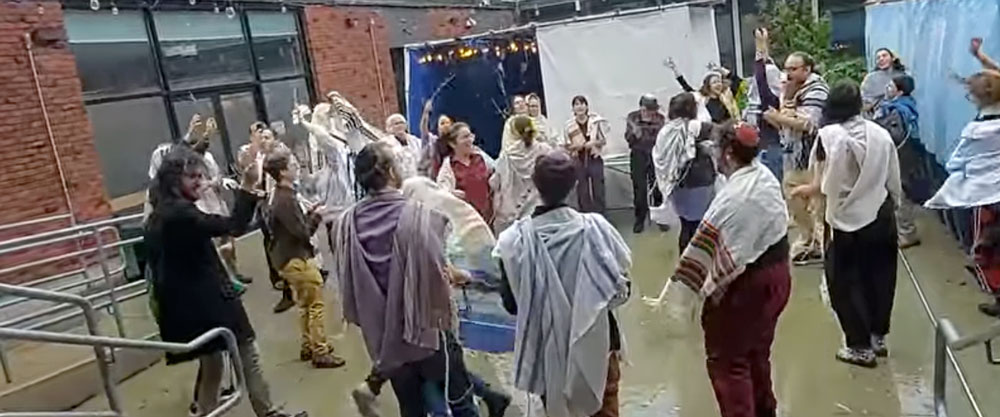
Rabbi Daniel Klein, Dean of the Rabbinical School of Hebrew College, shared this kavannah with students this week. (Above: Rabbinical students danced in the courtyard (and in the rain!) on Monday to celebrate the end of Sukkot (Hoshanah Rabbah).)
The Zohar teaches that Hoshana Rabbah, the final day of Sukkot, marks the completion of the season of atonement and judgement. On it, all the work we have been doing since the beginning of Tishrei officially comes to a close as the verdict is delivered. It is the day that we stop this intensive process of transformation because it cannot go on forever.
In his book Netivot Shalom, the Slonimer Rebbe offers a powerful derash on this idea based on a pasuk from Shir HaShirim (8:6):
שִׂימֵנִי כַחוֹתָם עַל־לִבֶּךָ כַּחוֹתָם עַל־זְרוֹעֶךָ
Set me as a seal on your heart, as a seal on your arm
The Slonimer teaches that Yom Kippur is the ‘seal on our hearts.’ It concludes all the inner work we have been doing to transform our minds and hearts to be more responsive to God. In contrast, Hoshana Rabbah is the end of Sukkot, a holiday characterized by physical actions in the world: building the sukkah and waving the lulav. For this reason, Hoshana Rabbah is the ‘seal on our arms.’ It is an effort to manifest our inner work through the action we take in the world.
 Hoshana Rabbah is thus about what we bring from this holiday season into our embodied lives—how we are going to manifest the inner transformation through concrete deeds in the world. This is reflected in the liturgical minhagim, or conventions, of Hoshana Rabbah as they mingle chol, moed, and Yamim Noraim nusacho—weekday, festival, and high holiday melodies— together, as if to remind us they also must come together in our lives.
I find it very moving that of all the days of the High Holidays, we spend Hoshana Rabbah together as a community. We will spend more time in the presence of the people here this coming year than many other people in our lives. These are the people we spend our days with who will witness, receive, and support what we have strived for and achieved during these fall chagim.
May the work you have done, the experiences you have had, the tefillot you have offered, the insights you have gained, and the new habits you have tried to form help you be the highest, deepest, most sacred versions of yourself you possibly can this year—experienced internally and expressed in the deeds of your life. And may you be caring, supportive, and loving presences for the people in this room and the people in your lives, helping us all to be the people we are and strive to become.
A Fragile, Tenuous Hope: October 7, Hostage Release, and Ceasefire Reflection
Today marks the Hebrew calendar anniversary of the attacks of October 7, 2023. We had planned to take time during tefillah to commemorate that horrible day and the devastating war that has ensued. But stunningly—amazingly—we find ourselves not only in a moment of commemoration but also of celebration and hope.
This morning, the remaining 20 living hostages who had been held in captivity for two long, nightmarish years were finally released, returned to their families, their loved ones, their lives.
And in the last few days, a cease-fire has gone into effect in Gaza. The Israeli military is beginning to pull back. More aid is flowing into the region for people in desperate need of food and medicine. Palestinians are beginning to return to their homes or what is left of them.
It is an extraordinary day.
זֶה־הַיּוֹם עָשָׂה הה נָגִילָה וְנִשְׂמְחָה בוֹ
This is the day God has made. Let us rejoice in it. (Psalm 118:24)
But two weeks ago, it was almost unthinkable that it would arrive. A breakthrough, a change in circumstances, was unimaginable. The tragic events of October 7 and what that terror set off seemed like they would go on forever.
Sukkot and Hoshana Rabbah mark a time of celebration in the midst of uncertainty.
In this miraculous moment of celebration, I also want to commemorate the events of these past two years. I want to commemorate the 1,200 people, mostly Jews, who were murdered by terrorists on October 7 2023, 22 Tishrei 5784 and the countless more who were wounded. They were primarily civilians, children and parents, younger people and older folks, all going about their daily lives, some attending a music festival, brutally, horribly murdered.
I want to commemorate the hostages who were taken and the suffering they endured. Some were killed in the tunnels of Gaza. Some were released earlier, and some were freed just today, after years of captivity.
I want to commemorate the families of our Israeli siblings who are mourning loved ones; people recovering from injuries; and a society and country—small and interconnected, where most everyone is at most one degree separated from someone who was murdered or wounded, with everyone to some degree traumatized and terrorized by that day and the two years of war since.
I want to commemorate the Jewish people worldwide, also confronting our oldest and deepest fear of an inhospitable world—anti-Semitism rising in the aftermath of the attacks and the war that has unfolded, frighteningly violent and even murderous, as seen most recently in the terrifying attack and loss of life in Manchester, England.
But this acknowledgment of and focus on the particular, the Jewish people’s suffering, pain, and trauma, on October 7 and its aftermath, should not cause us to be closed or indifferent to the pain of others. Tending to our own pain should open us to the suffering of others, our own broken hearts leading to more capacious hearts. This is in fact one of the core teachings of our tradition—remember and care for the stranger, for we were once strangers in a strange land.
So I also want to acknowledge and commemorate the pain and suffering of Palestinians in this devastating war in Gaza—the tragic loss of life, the destruction of homes and infrastructure, people displaced and at times lacking sufficient food and water to survive.
But on this day, I also have hope.
I am not naïve. Given all it will take to achieve an enduring end to conflict, all the obstacles to overcome, the hope is fragile, tenuous. But that is the time period we are in, mythically, in our sacred calendar.
Sukkot and Hoshana Rabbah mark a time of celebration in the midst of uncertainty. The annual harvest is complete and we rejoice for what we have received. But we don’t know whether it will be enough to carry us through the winter. We don’t know if the seeds we will plant for the spring will receive the right amount of sunlight and water, heat and protection, to grow abundantly for the next harvest.
We just don’t know, and we only have so much control. In fact, we have very little power and control, as we are dependent on so much beyond us.
And so on this holiday, we call out, we pray, over and over again, Hoshana, Hoshana. Save us. Save us. Help us. Care for us. Protect us. God, we need You because this world is so much bigger than us and our need is so immense.
Please God, source of salvation, tend to these precious and precarious seeds of hope that have been planted this week with the return of the hostages and the cessation of fighting, and help them grow into an abundant harvest of peace.
 Rabbi Daniel Klein is Dean of the Rabbinical School of Hebrew College in Newton, MA, where he was ordained in 2010. He also holds a Master of Jewish Education degree from Hebrew College.