

News Highlights Commencement 2026:
Robert Bank Honorary Degree
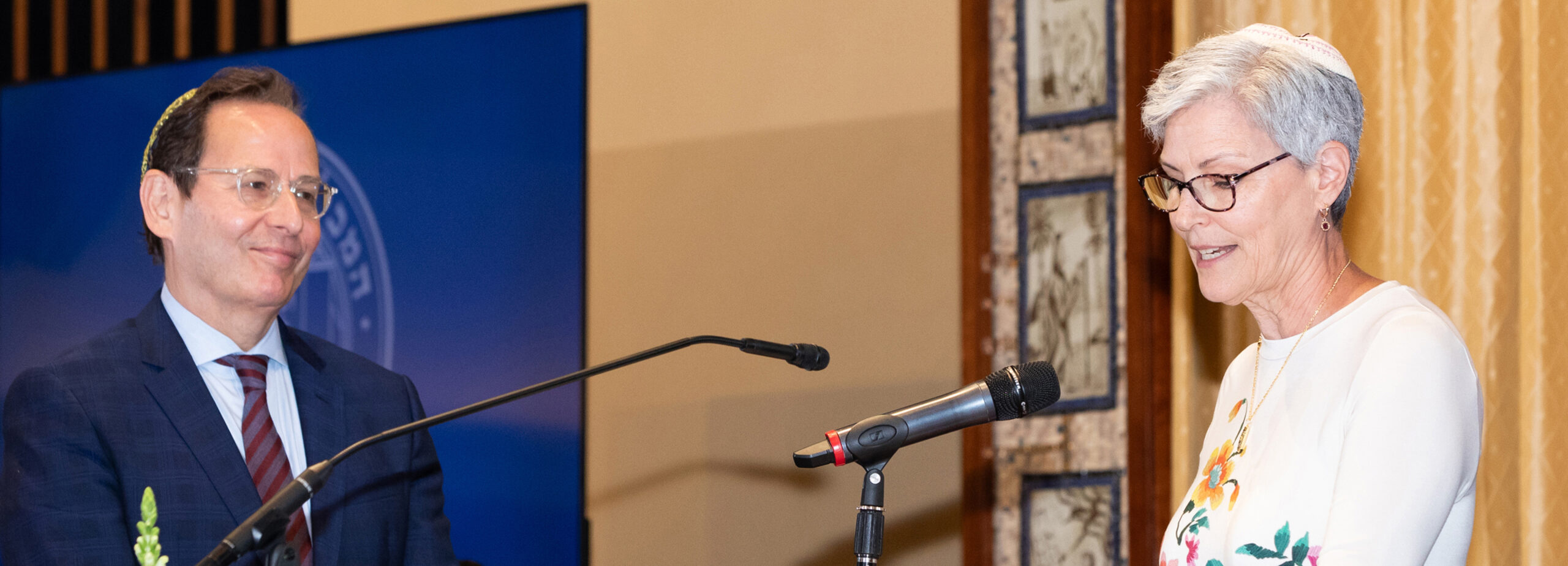
Robert Bank, former President and CEO of American Jewish World Service, received an honorary degree at Hebrew College’s Commencement ceremony on May 31 2026. His remarks are below. (Pictured: Rabbi Suzanne Offit presents Robert Bank with his honorary degree.)
Good afternoon.
President Anisfeld, Board of Trustees, Faculty, Rabbi Offit — thank you for the generosity and warmth of this welcome.
To the Class of 2026: Congratulations! Today you cross a threshold. In our tradition, we don’t just mark these transitions. We sanctify them. And it is an honor to stand with you in this holy moment.
As I look out at you, I feel hope. I see leaders at a time when wise and moral leadership is sorely needed. I see rabbis, educators and artists who will make a demonstrable difference, both in the lives of people close to home, but also in the world at large. And I don’t need to tell you, my friends, that our world is deeply broken.
We are living through a time of profound division and staggering inequality. The core values of human dignity and equal worth – enshrined in our faith traditions, our country’s Declaration of Independence, and the global Universal Declaration of Human Rights are under siege. Fear is rewarded. Cruelty is normalized. Difference becomes a reason for exclusion rather than an opportunity for encounter.
We know this reality all too well. As antisemitism rises – fueled and exploited by those in power here and abroad – we feel the pain of being targeted, vilified, and undermined. And within our own Jewish communities, we too often let disagreement harden into division, straining the bonds we most need to preserve.
Dear graduates: you already know this. So the question is not — what is wrong?
The question is: what do we do about it?
Parker Palmer, a prior recipient of an honorary degree from this very institution, speaks about contributing to building a better world by “standing in the tragic gap”: the gap between corrosive cynicism and irrelevant idealism. It is in this space that we discover our inner strength – to hold both the reality all around us, and our ability to cope, hope and act.
This, my friends, is where you are being called to live.
I learned something about this space when I was growing up in Cape Town, South Africa – a place of extraordinary beauty, and at the time, extraordinary brutality.
I learned about my mother’s cousin, Denis Goldberg, who was sentenced to life imprisonment for his role in the resistance alongside Nelson Mandela. Both Mandela and Cousin Denis were defended in court by Jewish lawyers. And the prosecutor representing the racist regime was also Jewish.
People from the same community, shaped by the same tradition, standing on opposite sides of a profound moral divide.
That stayed with me.
It taught me something simple, and uncomfortable:
We always have a choice.
We can choose to see, or choose not to see.
We can choose to act, or choose to look away.
We can choose to uphold dignity, or become complicit in its erosion.
Those formative years gave me one of my greatest gifts. Even amid brutality, I witnessed countless acts of kindness, empathy, and courage – good people choosing to do good. A few acted on a grand stage. But most worked quietly: easing individual suffering, pushing for better policies, insisting – day by day – that a better future was possible.
Throughout my career working locally, nationally, and globally – protecting tenants in New York, advocating during the HIV/AIDS crisis, and leading American Jewish World Service — I have seen what it takes to turn those choices into real change: three things.
First: get close enough to listen.
Real change begins with closeness. With humility. With reverent listening. In our tradition, listening is sacred. Shema – שְׁמַע – is not just a prayer. It is an orientation. It calls us to open ourselves to another person’s reality, to recognize our shared humanity and essential oneness. It reminds us that those closest to the pain are often closest to the wisdom needed to heal it. I’ve seen this to be true again and again: in one-on-one conversations, in communities a hundred strong, and in social movements carried forward by millions of souls.
Second: use your voice and power.
Advocacy is just as sacred. The word advocate comes from the Latin vocare, “to call.” To advocate is to be called toward another’s voice — to stand with them, and to champion their cause.
But our tradition asks even more of us. It speaks about a melitz yosher – מֵלִיץ יוֹשֶׁר – not just someone who speaks on behalf of another, but someone who searches for the light in another, and insists it be seen.
As rabbis and educators, you will carry moral authority. People will listen. I’ve seen this firsthand — walking the halls of Congress alongside remarkable rabbis and other Jewish leaders, who have used their voice and power to advocate for global human rights.
One rabbi or educator is never just one voice. You represent communities. You help people decide what matters. You will shape how people understand compassion, responsibility and justice.
Use that power with care. And with courage.
Third: decide and act, even when the outcome is uncertain.
One of the great temptations of our time is paralysis. We look at the scale of suffering and injustice and think: what difference could I possibly make? But uncertainty must not stop us from doing what is morally right. There is intrinsic value in fighting for something even when victory isn’t achieved.
Choose something that matters to you. Support the organizations that are doing that work and inspire others to support them too. Money matters. Financial resources make strong organizations. Strong organizations make change.
And remember – this work is not yours to carry alone. As climate activist Bill McKibben says, “When people ask me, “But what can I [possibly] do as an individual, I say: stop being an individual.”
You did not arrive here alone. There are people in this room who have supported you, shaped you, challenged you, believed in you even when you didn’t believe in yourself.
Carry them with you. And build communities that help others carry the weight of our world too.
Annie Besant, a 19th century British reformer who fought for workers’ rights, women’s suffrage, and education, said “Someone ought to do it, but why should I? Someone ought to do it, so why not I? Between these two sentences lie whole centuries of moral evolution.”
Dear graduates, you have traversed those centuries of moral evolution because you have answered “why not I,” with a resounding “of course, I.”
Our playbook for that is not new. We celebrated receiving it just weeks ago during Shavuot. You are part of a lineage that reminds us — 36 times – to care for the other. Why 36? Because it is that hard. And that essential.
Mazel tov, graduates. Go forward with humility, courage, and the conviction that your actions matter.
Because…they do.