

News Highlights Commencement 2026:
Bejamin Shevach Award at Hebrew College
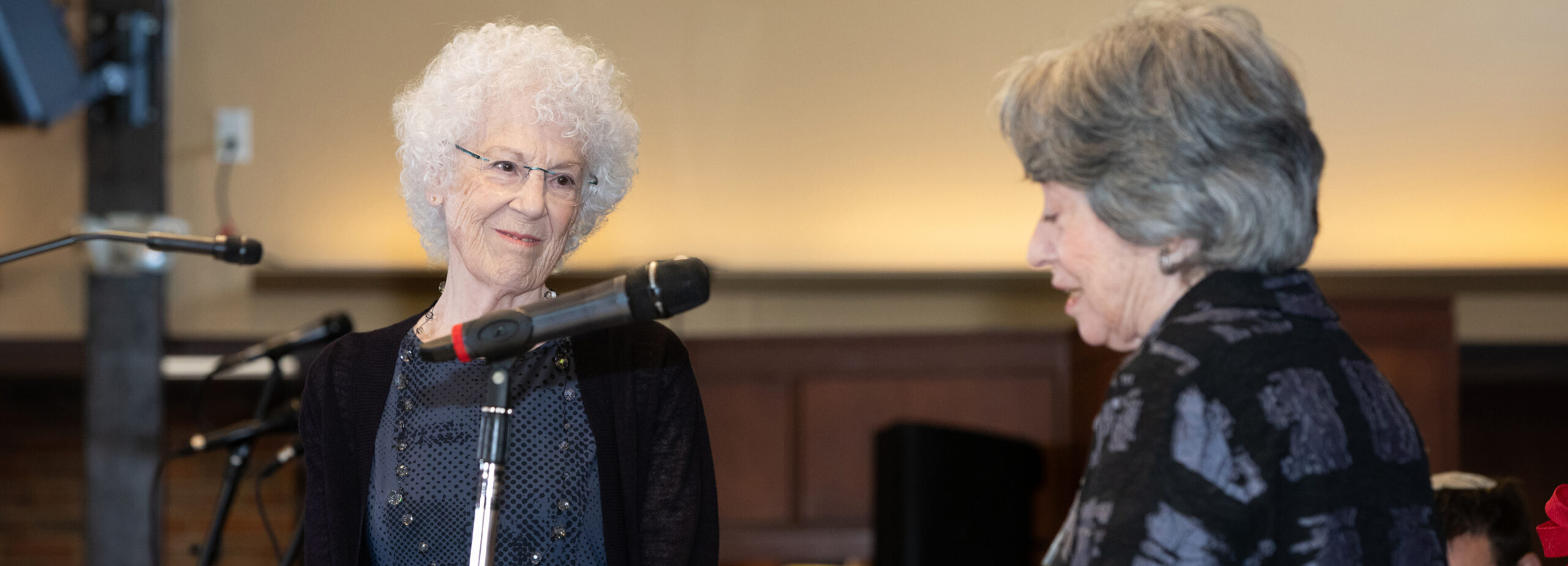
Sharon Feiman-Nemser, Jack, Joseph and Morton Mandel Professor Emerita of Jewish Education at Brandeis University and founding director of the Mandel Center for Studies in Jewish Education, received the Benjamin Shevach Award at Hebrew College’s Commencement ceremony on May 31, 2026. Below are her remarks.
Receiving the Benjamin Shevach Award from Hebrew College has special resonance for me, personally and professionally. I’d like to highlight three connections.
The first has to do with the original mission of Hebrew College, founded in 1921 as the Boston Hebrew Teachers College. In the opening decades of the 20th c, Hebrew Colleges were established in large U.S. cities to train a new kind of teacher for a new model of Jewish education, the modern communal Talmud Torah. Inspired by cultural Zionism and the revival of Hebrew, these Talmud Torahs offered an intensive curriculum featuring the study of classical texts and the study of Hebrew language and literature, all taught in Hebrew, ivrit b’ivrit. While Hebrew College has expanded its mission, I feel a special connection to the early commitment to content-rich, reform-minded teacher education.
My second connection has to do with Benjamin Shevach. Shevach and his predecessor Louis Hurvich who founded Boston’s Hebrew Teachers College were leaders in the movement to replace the old fashion cheder with modern Talmud Torahs staffed by qualified teachers. Shevach headed the Bureau of Jewish Education after Hurwich and championed the five-day a week school with its intensive, elitist Hebraic curriculum. He was known for upholding high standards for both students and teachers.
Learning about Bejamin Shevach, I was reminded of my grandfather, Saul Kleiman of blessed memory, who was part of the same reform. In l904 my grandfather immigrated from Poland to Boston where he quickly affiliated himself with other scholars, writers and teachers who shared his passion for Hebrew language and literature. In l912 Kleiman was invited to Kansas City, MO to start a modern communal Talmud Torah. His major innovation was his fanatical insistence on ivrit b’ivrit as the method of instruction.
My grandparents not only spoke Hebrew at home, they kept my mother home from public school through second grade. My grandfather also created an imaginary pen pal from Palestine who wrote letters to my mother in Hebrew and responded to her letters. For my grandfather, Hebrew was the key to Judaism’s rich cultural treasures — Hebrew not so much for prayer but for Jewish literacy, for gaining access to the Bible and the poems of Bialik, for keeping people connected to a living tradition in an open society. So my second connection is with my grandfather who seems to have shared both strong commitments and a certain temperament with Benjamin Shevach.
My third connection is with my mother, z’l who made Judaism a source of beauty, learning and fun as I was growing up in the ‘40s and ‘50’s in Canton, Ohio. Every morning through elementary school my sisters and I got up at 6:30 so we could be downstairs in time for our daily Hebrew lesson before we had breakfast and went off to public school. We studied Bible, Hebrew language and literature. We read Hebrew story books and wrote book reports in Hebrew which we sent to my grandfather in Kansas City for his comments (and of course corrections). Before each holiday my mother would gather us around the piano to learn songs and blessings. We also learned Israeli songs and dances and developed a deep attachment to Israel. Every Fall, we walked over to the JCC to fill out a pledge card for $5.20. Each week we put 10 cents from our weekly allowance in our tzedakah banks. Then at year’s end we returned to pay our pledge. It was a powerful combination of instruction and enculturation, an education that engaged the head, hand and heart.
So this award connects me to my mother who clearly influenced my decision to leave a satisfying academic career in education and come to Brandeis University to fill a new chair in Jewish education. At Brandeis, I was able to use my scholarship and practical experiences to advance the study of teaching and learning in Jewish education and the professional development of Jewish educators. Being able to connect my intellectual and personal commitments has been an enriching and exciting opportunity.