

Shared Campus Where Torah Meets Creativity
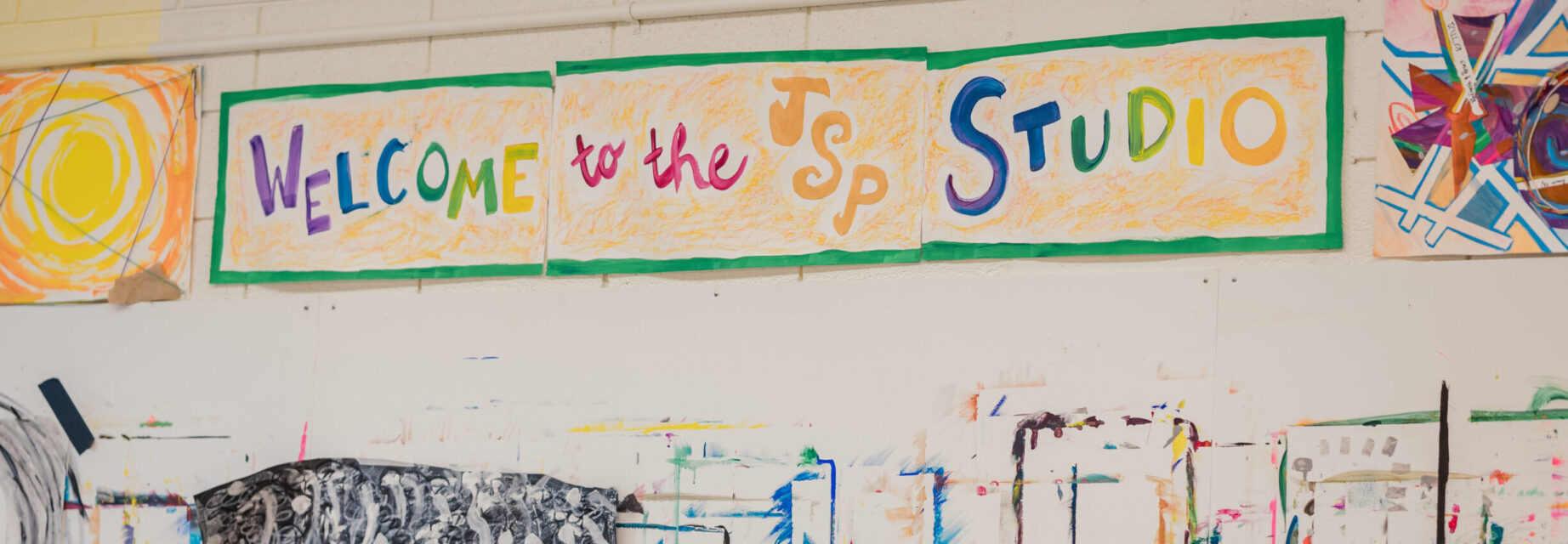
The Hebrew College Beit Midrash is lined with books: volumes of Talmud and other Jewish texts, grammar primers, prayer books, and commentaries from every era of Jewish history. Just down the hall, the Jewish Studio Project’s Boston Hub is crowded with art supplies and collage materials, with paintings and handmade posters adorning the bright walls. (featured photo credit: Rebecca Bloomfield, Jewish Studio Project)
Though the two spaces are feet apart, the distance between their approaches may seem greater: one steeped in centuries of commentary, interpretation, and tradition; the other inviting people to cut, arrange, paint, and create something they could not have anticipated. But for Rabbi Adina Allen `14, the founder of Jewish Studio Project (JSP), they are two sides of the same coin. As a student at Hebrew College’s Rabbinical School, Allen began exploring how the art-making practices she knew from her mother’s art therapy career might open new ways into Torah study. She went on to co-found JSP with her spouse, Jeff Kasowitz, developing a methodology that brings Jewish wisdom into conversation with creative practice. When JSP began looking for a home for its first regional hub, Hebrew College offered more than a place to expand its work. The organization could return to the campus where Allen’s experiments had helped lay its foundations.
For Naomi Zipursky, a Shanah Dalet student in Hebrew College’s Rabbinical School, JSP has been central to conceptualizing what kind of rabbi she wants to be. She had encountered the organization earlier, while working as a Hillel professional, but it was at Hebrew College that she began to explore the JSP method more deeply. A seminar led by Allen helped her see how art-making might become part of her own learning and, eventually, her work with others. Zipursky had always played music, but she understood that experience as bringing someone else’s composition to life. Making visual art offered something different: a way to process what she was learning without having to find the right words. It also asked her to loosen her grip on getting things right. At JSP’s recent three-day summer immersive, she made a piece she considered so striking that she had to share it: “I texted my friend saying I just made the ugliest art, and it was amazing!” she says. “Creating something good just means creating it.”
That shift has extended beyond Zipursky’s own creative practice. She has facilitated a JSP-inspired Shabbat learning experience for the Temple Israel’s Riverway Project, and is attending a rabbinical student tefilah group that explores the relationship between art and prayer. For Annie Fortnow, JSP’s Boston Regional Director, this movement between the Studio and the wider community is central to the partnership. “Rabbinical students experience our methodology in the studio and carry it into their internships and communities,” she says. “Bringing an embodied, imaginative practice into the rigorous learning of the beit midrash opens students to new insights and possibilities. In turn, they’re helping us build creative capacity across the Boston Jewish community.”
Zipursky hopes to cultivate a rabbinate spacious enough to welcome what people bring and to help them discover possibilities for Jewish life they might not have imagined. This Rosh Hashanah, she brought some of these ideas to the pulpit at Temple Beth Elohim in Wellesley, delivering her first High Holiday sermon. Reading the opening of Genesis alongside the daily liturgy, Zipursky explored the Jewish tension between understanding creation as a singular event in the past, or as an ongoing process in which human beings participate: “Creation is a moment in our past, a constant in our present, and a catalyst for our future.” Drawing on Allen’s book, The Place of All Possibility, she invited congregants to think of creativity not as the province of artists, but as a way of shaping the world: through teaching and learning, acts of care, and the courage to imagine something different from what exists. To close, Zipursky offered a blessing composed by Rabbi Allen for recitation at the beginning of a creative endeavor.
The connection between Hebrew College and Jewish Studio Project began with one rabbinical student’s experiments in bringing art into conversation with Torah. Now, with JSP’s Boston Hub on the College’s shared campus, that conversation continues in the work of students like Zipursky. The books in the beit midrash hold generations of Jewish argument, interpretation, and imagination. The studio offers another way to claim that inheritance by making something, seeing what emerges, and discovering where it leads. For future rabbis, the work of creation may begin with a collage or a smear of oil pastel. It may continue in a sermon, a new approach to prayer, or an invitation for a community to discover new creative possibilities within Jewish life.
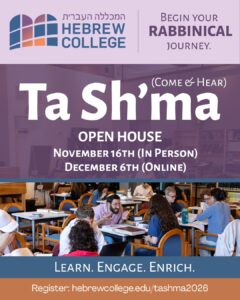 Meet students and faculty at one of our fall open houses, Ta Sh’ma (Come & Hear) November 16 (in-person) or online (Dec. 6).
Learn more and register.