

News Highlights Ordination 2025:
President’s Remarks
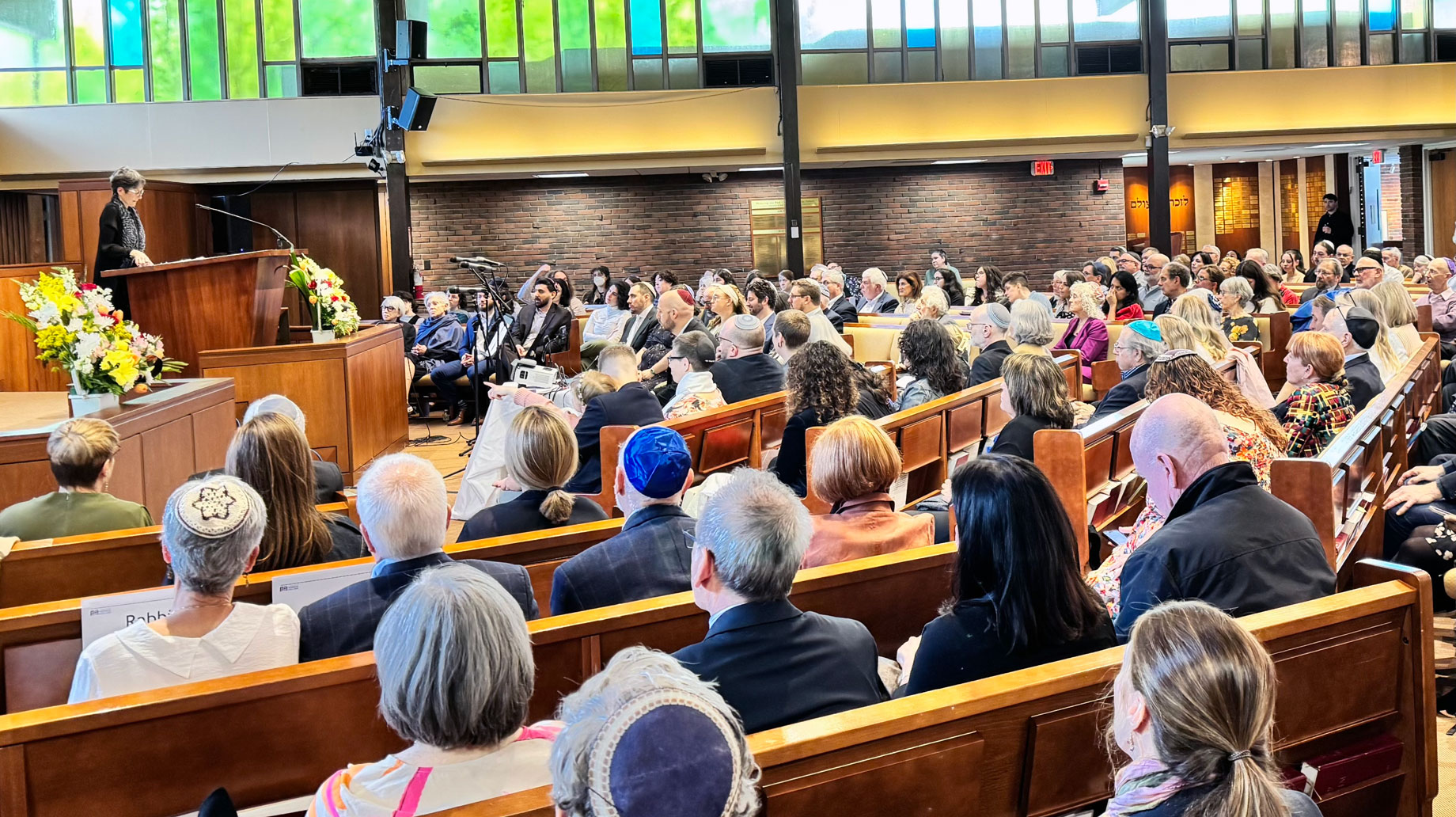
I want to start with a personal memory.
When I was growing up, my mother volunteered as a “Great Books” discussion group leader in schools and in our local prison. I have vivid memories of her sitting at the kitchen table, toiling over a one-act play or a short story, preparing for those discussions. What did it mean to prepare? It meant nothing more and nothing less than finding the right questions to ask.
What were the right questions? First, they had to be questions that required a close reading of the text. Second, they had to be questions that she didn’t already know the answer to. She could not have a pre-packaged answer in mind.
And finally, the right questions had to be questions that mattered. She simply wouldn’t ask a question unless she really cared about the answer.
It was only much later that I came to see how deeply her approach reflected and embodied the ethos of the Beit Midrash. The primacy of the question. The presumption of multiple interpretations, multiple possibilities. The commitment to close, really close, reading. The connection between learning and friendship. The search — together — for questions that matter.
Needless to say, the implications of this emphasis on the search for the right questions extends far beyond the act of reading and discussing great literature or the walls of the Beit Midrash.
It is a stance toward life, a stance that requires humility, courage, and compassion in the face of uncertainty. If I have learned anything in three and a half decades of being a rabbi, it is that I do not have answers to any of the most honest and serious questions that I’ve been asked. How could God let this happen? Why should I go on living? What happens after we die? Why is there so much hatred and cruelty in the world?
To live with a sense of one’s own lack of answers — what the writer Grace Paley of blessed memory calls “un-understanding” — can be humbling and unsettling — but I think it is actually the most solid ground we stand on.
This is the ground I hope you feel beneath your feet as you leave our Beit Midrash —the ground of our shared questions, the ground of our shared humanity as we encounter the endless mystery and complexity of life.
I don’t need to tell you that you are stepping into leadership in a profoundly challenging time. Our people is in great pain. Our world is drenched in grief. For many reasons, there will be an even greater temptation to feel that you must have the answers — and that you must have them quickly, preferably, ready to post online within a few hours.
I learned a piece of Torah last week from Rabbi Nehemia Polen that has completely stolen my heart. I offer it to you in this moment because I think it speaks powerfully to this quandary and is so important for the sacred work that we all do.
It is from the Pri Ha’aretz Menachem Mendel of Vitebsk from the Hasidic community of Tiberius. Commenting on the story of the ger — the proselyte —
who approaches Hillel and asks him to teach him the whole Torah while he is standing on one foot.
We usually read this story ascribing a kind of impatience and impudence to the student, and we are impressed with Hillel’s willingness to indulge the request — what is hateful to you, do not do to your fellow. Go and learn.
Menachem Mendel of Vitebsk has a reading of this encounter that I had never considered! He invites us to actually listen to the question behind the question What the ger is really asking — he suggests — is teach me Torah that will keep me from toppling over — she’lo yipol. Teach me Torah that will enable me to keep standing when I feel wobbly, unsteady — when I am buffeted by events of the world. When life destabilizes me and threatens to blow me over. What he is really seeking is emunah, in Nehemia’s words: “A sense of balance, firmness, integrity . . . fusion of all aspects of being.”
It is an exquisitely empathic reading — there are certainly times when most of us have felt like that ger — afraid of life toppling us over, desperately wanting an answer to hold onto.
It is also an exquisitely responsible reading — when we are in Hillel’s position, when someone comes to us — how might we listen more carefully to the question behind the question? To the vulnerability behind the rushed request?
And it is, I want to suggest, a reading that cracks open the wise humility of Hillel’s response in a beautiful and unexpected way. It takes seriously the urgency that the questioner feels: think about what is hateful to you and try not to do that to others. In other words, remember that you don’t stand alone. Look around you, and pay attention to the needs of the other people who may also be feeling a little wobbly beside you.
It reminds me of when I was in labor with my first child— writhing in pain — and suddenly the midwife said to me, “Don’t forget to be kind to your husband.” My first reaction was: Um. WHAT?!?!?!?!?! And then I noticed how steadied I felt by her reminder. You are in pain but you still live in a moral universe. You are still responsible to another person.
The next thing Hillel says is simply — “go and learn” — remember that the story of this moment is not the whole story. Tether yourself to a life of Torah which is to say a taste of that which is timeless and eternal, which is to say a life of shared questions — a life of shared searching with those who’ve come before us and those who will come after us, with those who are searching beside us and with the divine voice that whispers within us and across the table between us.
As you go forth from our Beit Midrash, may this sense of emunah steady you and help you steady others with empathy, responsibility, and wise humility wherever you go.
Ken yehi ratzon.