

Alumni Navigating Jewish Leadership on College Campuses

Every year Hebrew College sends our newly minted rabbis out into the world to do the critical work of helping lead our Jewish communities around the country and world. Our alumni join pulpits of all denominations, lead non-profit organizations, offer pastoral care, lead social and environmental justice initiatives, build interreligious bridges, and teach in Jewish settings from gan (kindergarten) to university. Over the past year and a half, campus rabbis have navigated the controversy and turmoil roiling college life. Between the rise in antisemitism and post-October 7 protests and strife, the role of campus rabbi can be fraught.
We learned more about these challenges a year ago at our 2024 spring gala when then Harvard Hillel Rabbi alumnus Rabbi Getzel Davis `13 shared his insights at our panel discussion, “Finding Hope”, and again in December 2024 when Hebrew College hosted a session of Hillel International’s annual conference. As the challenges continue to surmount, we reached out to some of the Hebrew College rabbinical alumni who work on college campuses to hear their perspective, wisdom, and insight on navigating this moment.
We are grateful to these Hebrew College alumni for sharing their thoughts:
Rabbi Jordan Braunig `14, Jewish Chaplain, Emory University
Rabbi Aaron Fine `09, Executive Director of Hillel at UMass Amherst
Rabbi Talia Laster `22, Campus Rabbi for Grinspoon Hillel at Cornell University
Rabbi Stephanie Max `19, Executive Director of Texas Hillel
Rabbi Lisa Stella `14, Senior Rabbi at University of Michigan
Rabbi Seth Wax `13, Jewish Chaplain at Williams College
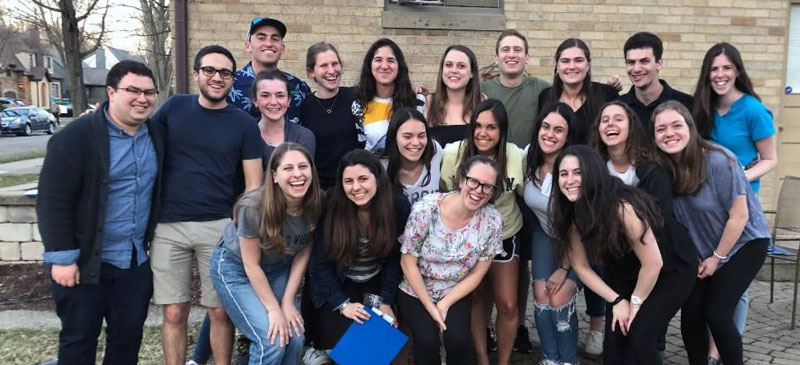
These interviews have been edited and condensed for length and clarity. (Pictured above: Rabbi Talia Laster and Cornell students)
Q. What makes a good campus rabbi?
Rabbi Seth Wax: A good campus rabbi knows how and when to listen, how and when to speak, how and when to encourage, and how and when to nudge or cajole a student. But I think the most important thing is to care for the students and to do what you can to help them in their process of becoming.
Rabbi Talia Laster: A campus rabbi needs flexibility to roll with quickly changing and often troublesome realities, kindness and an assumption of most people’s good will, and an easy ability to laugh. The ability to engagingly translate aspects of the tradition to contemporary sensibilities is also essential.
Rabbi Stephanie Max: You have to be a team player, whether that means setting up chairs for an event, or teaching a fellowship, you have to see yourself within the broader ecosystem in order to serve students well.
Rabbi Lisa Stella: My approach to a campus rabbinate is that each student is a part of my congregation. This is a beautiful challenge, considering people join synagogues for so many different reasons. Being a pluralist at heart helps. The vibrancy of Hillel is that we have something for everyone. While I have my personal boundaries and preferences, I am able to speak to the Judaism of all my students, and to help them grow into the Judaism that is best for them, regardless of how similar or different it is from mine. I have deep respect for my students wherever they are coming from, and try to lead with empathy and curiosity.
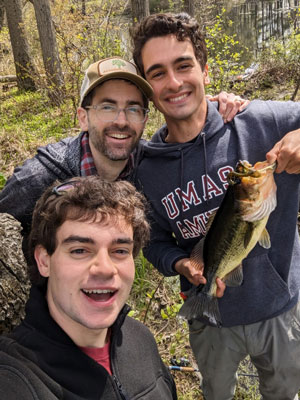 Rabbi Aaron Fine: A good campus rabbi gets to know students and lets students get to know them. This means not only bringing your rabbinic self to the job but also the rest of who you are. I started the “Rabbi’s Fishing Club” at UMass (right), and it turns out conversations while fishing can be as meaningful as while sitting in an office — but it’s more fun.
Rabbi Jordan Braunig: I think a successful campus rabbi identifies with students not as ‘kids’, but as adults who are having their perspectives widened, their critical lenses developed, and who are deep in the work of self-discovery.
Q. How has the role of a campus rabbi changed in your time in the role?
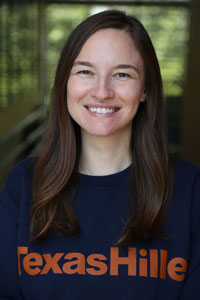 Rabbi Stephanie Max (right): I’m not sure that the role itself has changed as much as the context has changed. The challenges facing our students feel more intense, and that makes our responsibility to be present with them at this unique moment in their lives even more important. They still need opportunities to grow, learn, and connect no matter what.
Rabbi Aaron Fine: My role as Executive Director at UMass Amherst, and what it means to be a rabbi in that role, has evolved a lot over the past 11 years. Running a non-profit is always a bit of a rollercoaster, and I’ve worn many hats I never anticipated, from navigating financial crises to the pandemic and the post October 7 era on campus. Since October 7, a significant portion of my time is devoted to student support and advocacy, strategic relationship development, and campus leadership. While difficult, this has also been very fulfilling.
Rabbi Seth Wax: I was attracted to working at the Chaplains’ Office at Williams College since it was an interfaith team that explicitly placed spiritual care at the center of its work. That meant that whether we are organizing services and programs, supporting students, or teaching from our respective religious traditions, we do so with an eye toward caring for the person or people in front of us. As campus life has become more challenging, and over the past year and a half especially, I have made an ongoing effort to maintain that focus. So, in that way, my role has not changed at all; it’s just taken on heightened importance.
My job has been to offer care and support for members of the campus Jewish community and to help them make as much sense of this time as possible. To help them as they ask questions like, “Who am I? What do I care about? How do I create community with room for disagreement while maintaining my integrity?” These are critical questions, and it’s been a privilege to accompany students as they explore them.
University of Michigan Hillel students
Rabbi Lisa Stella: This is my tenth school year, but it feels like I started over again four or five years ago because of the pandemic, which caused a huge disruption in the institutional knowledge, culture, and leadership trajectory of our students. Hillel as a movement also has been shifting focus educationally to multi-session, cohort-based learning initiatives run by staff, which has affected the way I spend my time engaging with students.
Of course, Oct 7 drastically affected Jewish community and campus life in general. I have spent a lot more time providing support for students navigating various relationships on campus. Many Jewish students on campus feel like they are under a spotlight, regardless of their feelings about the war and their relationship with Israel, because of the ways in which antisemitism, Zionism, and justice work have been at the forefront of many conversations. There are more assumptions about people’s identities and politics. We are facing more siloing and exclusion over these issues than we ever experienced before. I spend a good deal of time developing relationships with administration and University partners to work toward supporting Jewish students on campus in productive ways.
Rabbi Jordan Braunig: I have been a campus rabbi for just over a decade and I think that, on the whole, the work has been consistent. Of course, I am aware of trends in rising anxiety and a falling sense of religious affiliation. Yet, at the end of the day, I am just a rabbi trying to help students feel connected to themselves, to their communities and to the Kadosh Baruch Hu.
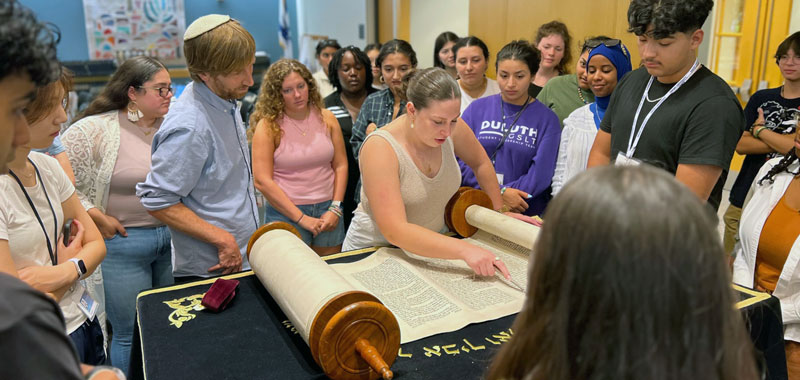
Rabbi Jordan Braunig with Emory students
Q. How are you helping your students make sense of the world and these times? What do they communicate to you about their needs as Jewish college students?
Rabbi Aaron Fine: In these complicated times, it’s been a priority of mine to double-down on rooting our community in core Jewish values, which we teach through both explicit and implicit education — compassion, learning, sacred disagreement, pluralism.
Students come to me and other Hillel staff for a wide range of help, from wanting to explore Judaism, to challenges with mental health, antisemitism, relationships and so on. I am struck that what they often want and need most is simple, but rarer than it should be — joyous community where they can find friendship, role models, and empowerment.
Rabbi Jordan Braunig: So much of my time is spent helping students navigate uncertainty. I think that they assume that means I am going to help them make their way out of feeling conflicted or ambivalent, but navigating uncertainty often means learning to live with it.
Rabbi Lisa Stella: I am not sure anyone can make sense of the world in these times … but I like to talk about the long arc of Jewish history, and the immediate power of Jewish ritual, to help us manage the uncertainty and stress of the world around us. We spend a lot of time focusing on Jewish joy, community, and Jewish time — Shabbat is a major source of resiliency. It’s countercultural to rest, to linger, to unplug, however that might look for you. At Michigan, we talk a lot about well-being from a holistic standpoint — spiritual wellness is part of that bigger picture. I want to help students find the ways that Judaism adds value and meaning and purpose to their lives beyond their academic success.
Rabbi Seth Wax: As a college chaplain, I view my primary responsibility as accompanying and supporting students in their spiritual, emotional, religious, and moral growth. Often, I simply listen to what they have to say and encourage them to explore their feelings in a safe and supportive context. I hope that by providing space for students to get familiar with their inner lives and emotions, they can act in ways that align with their values, rather than the heat of the moment.
I’ve heard many things from Jewish college students about their needs. One is the need for recognition and community. It can be very lonely being Jewish on campus today, and they need people with whom they can share their unique needs and desires. They also want to be able to live simply as college students. By and large, I think they are able to do that.
Rabbi Talia Laster: Jewish college students’ stories are so frequently simplified in the media to convey a black and white picture, while their lives are complex and full of color. I try to help them focus on that color in order to validate their own feelings and to help them humanize the headlines more broadly.
My students here at Cornell are quite busy and academically driven, while also just as focused on their social lives and having fun. Oftentimes, the greatest effect the issues of the world have on them is the social anxiety and alienation that exists when other students judge them or distance themselves on the basis of a political leaning, religious identity, or organizational affiliation. In the last year and a half, this anxiety led some students to want to engage more deeply across the differences they encountered on campus. While some gravitated toward structured dialogue, what most really crave is casual, positive encounters with students from different backgrounds. This is what many are missing, and we are all still trying to figure out how to facilitate that.
Q. What do you enjoy about working with college students?
Rabbi Lisa Stella: So many things! Campus life is so special — emerging adulthood is a tumultuous time, and full of possibility. This is the time when people are able to focus most fully on the kind of adult they want to be in the world. They make their first adult (Jewish) decisions about how much they want Judaism to impact their lives, their leadership, and their time. I find that students are open and yearning for learning that is beyond their field of study, focused on how they will be in the world, not just what they will do.
Rabbi Jordan Braunig: I feel so drawn to people who are figuring out how to be in the world and who they want to be. I often say that no student shows up to a meeting with me or a program that I am running because they have to. It is a delight to see people choosing to explore their Jewish identity of their own accord. I also like the challenge of proving that ancient traditions can be relevant to our lives.
Rabbi Aaron Fine: One of the things I love about Jewish community on campus is that there is constant renewal —25% of our population is new every year. We usually think of l’dor va’dor in terms of decades, but in Jewish campus community the transmission of living tradition happens between freshman and senior year, as students inherit community from their peers, make it their own, and pass it on.
Q. What programs and initiatives have you enjoyed developing for your students?
Rabbi Aaron Fine: Some of the programs I enjoy the most are ones that leverage my work with campus partners to create meaningful opportunities for students. Events in that category include an annual Shabbat and discussion with the Chancellor, discussion events with our elected officials, Jewish faculty-student gatherings, and a “Share Our Table” Kosher-Halal meal that I organized with Jewish and Muslim students and UMass kosher dining for three years.
Rabbi Stephanie Max: I’m not sure that I can pick just one, but I’m always proud when the students take ownership of something, whether that’s taking their peers to coffee and leaning into one-on-one engagement, or running campus-wide programs like Israel Block Party, which has been happening at Texas Hillel for 25 years.
Rabbi Seth Wax: I’ve really enjoyed building a spiritual direction program with students. I currently facilitate six groups of students who each meet monthly to reflect on their inner lives together. It’s been a powerful way to build community around shared reflection, listening, and emotional vulnerability.
I’m also developing ongoing opportunities for dialogue on Israel and Palestine, utilizing tools I learned with the organization Resetting the Table. I’ve found that students — really, everyone — benefits from structured opportunities to articulate our own positions on Israel while hearing from others with whom we may not agree.
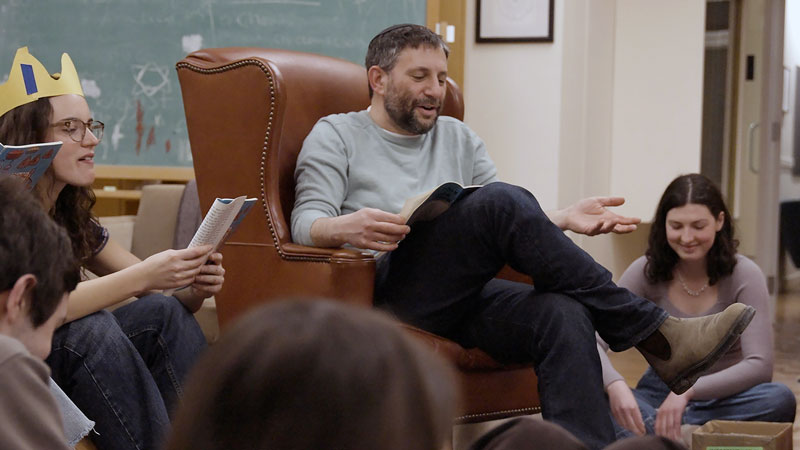
Rabbi Seth Wax and Williams students
Rabbi Jordan Braunig: I started a program at Emory that focuses on student flourishing. We work on listening skills, on making space for others to share, and on building community. For many students who identify as more spiritual than religious, there is a sense of something sacred or special about one-on-one connection.
Rabbi Talia Laster: I love teaching Jewish learning cohorts. We offer classes from Hillel International, such as “Sex, Love, and Relationships” and “Life’s Big Questions”, as well as others, like the Jewish Roots Fellowship, for people just starting out in an adult exploration of Judaism. These are a chance to get to know curious students over several weeks and foster a mini community which would not have otherwise existed.
We brought Rabbi Deborah Sacks Mintz to give a participatory concert in the fall, and I loved hearing from students how it exposed them to a completely new approach to Jewish music and spirituality.
I have also really enjoyed working with interfaith partners to create dialogue programs, a Jewish-Muslim Alliance, a “Religious Self-Defense” program for LGBTQ+ students nervous to go home for Thanksgiving, and trainings for faculty about how to approach academic accommodations for religious observance.
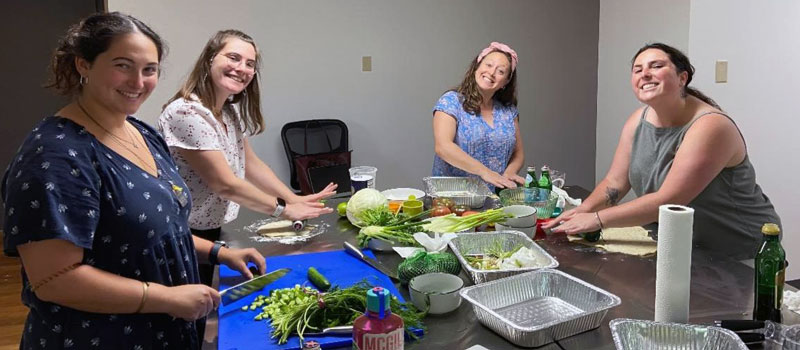
University of Michigan Hillel students cooking with Rabbi Stella
Rabbi Lisa Stella: I am most excited about recently renovating a kitchen space at Hillel to teach cooking classes to students. Food is a deep but accessible way to explore Judaism, and I have loved developing a class called “Knead to Know” which teaches students about Jewish foodways, gives them tools to feel more capable in the kitchen, and explores the concepts of hospitality, generosity, and gratitude in Jewish practice.
I teach a seminar at Hillel for second semester seniors. Each week a few seniors cook dinner with me for the rest of the group, and then we eat and learn
together. The seniors reflect on their life in college and think about life after, hopefully easing the transition a bit. It’s also meaningful because this work is about equipping college students with the tools to practice Judaism as adults after college, and this shows our investment in them beyond what they do when they are on campus.
I am also very excited about recently renovating a kitchen space at Hillel to teach cooking classes to students. Food is a deep but accessible way to explore Judaism, and I have loved developing a class called “Knead to Know”; which teaches students about Jewish foodways, gives them tools to feel more capable in the kitchen, and explores the concepts of hospitality, generosity, and gratitude in Jewish practice.
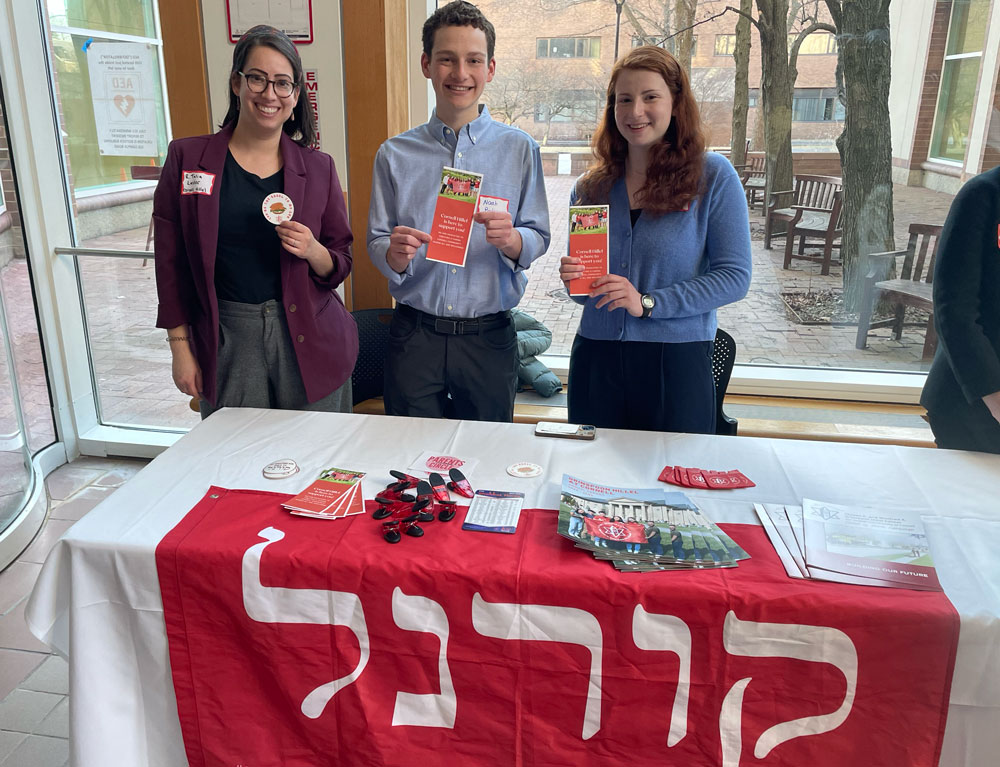
Rabbi Talia Laster with Cornell students
Learn more about the Hebrew College Rabbinical School and our alumni.
Explore Graduate Programs Professional Development Support Our Work