

Exodus Build Small
Parashat Terumah (Exodus 25:1-27:19)
A few weeks ago, I gathered with approximately 200 seminary students and clergy from the Boston area in a prayer vigil for those affected by the surge in immigration enforcement in Minnesota. We heard troubling stories from Minnesota clergy about how Black and brown people in their congregations have been sheltering in place, afraid to go to work or drop their children off at school, lest they never make it back home. And we heard powerful stories of people organizing to protect their neighbors: arranging safe rides to work; donating and distributing groceries; holding prayer services in living rooms instead of churches; and showing up on the streets in sub-zero temperatures to offer peaceful witness and protest.
In moments of crisis, many people often feel moved to show up, but that overflowing of emotional energy—fear, anger, grief, love, desire to help—doesn’t always lead to effective action. It’s easy to channel that energy into expressions of moral outrage; it’s much harder to channel it into meeting people’s tangible needs in the short or long term.
An effective and well-organized communal response to a crisis, like the one we have seen in Minnesota, doesn’t just happen spontaneously. It requires a long, slow process of building up infrastructure and relationships. In Minnesota, this process has been going on for years.
Many of the people around me are trying to figure out how to start or plug into this kind of work in our own communities—how to build real resilience and interconnectivity, so we can care for each other through whatever crises may come. It’s an ambitious goal. In a time when so many of us are already stretched thin, how can we even think about where to start reaching out?
In order for a community to build something big, Parshat Terumah teaches us, we have to start small.
In Parshat Terumah, God gives Moses a set of instructions for building the Mishkan, a holy sanctuary made out of precious materials where God will “dwell among” the Israelites in the desert (Shemot 25:8).
Imagine the Israelites: newly freed from slavery, fleeing the only home they’ve ever known with little more than the unleavened bread on their backs. They’ve just made a covenant with God. They’re terrified and exhilarated. They pool together all their most precious resources for this first project that they are undertaking as a community. The stakes are so high. If they were to focus on the end goal—building a sacred space beautiful enough for God to dwell in—they might be so overwhelmed they could never even begin.
So here is the wisdom of Terumah: we receive three entire chapters of construction details, specifying materials, dimensions, layout, and order of operations. The Israelites should begin by making “an ark of acacia wood, two and a half cubits in length, one and a half cubits in width, and one and a half cubits in height,” overlaid with gold, with a specific ring-and-pole mechanism for transportation (Shemot 25:10-14).
That’s better. That’s a small enough place to start.
This winter, the Hebrew College community had the privilege of learning with Meir Lakein, co-executive director of JOIN for Justice, a national organization that helps Jews learn how to organize their communities more effectively to achieve positive social change. He taught us some principles for effective organizing, one of which was: narrow the issue.
It’s easy to get overwhelmed by the call to build something—a home, a society, a world—that is beautiful and care-filled and peaceful enough to be worthy of God. But we don’t have to build a perfect world all at once. We just have to solve one concrete problem, and then another. We have to trust that the imperfect work of human hands, measuring one plank, one ring, one curtain, one table at a time, is enough.
When faced with an impossible task, start by making it smaller.
Much of the organizing in Minneapolis has taken place on a hyperlocal scale—not only neighborhood by neighborhood, but even block by block. People have built relationships of mutual care with their neighbors, weaving a tight fabric of safety and support across the city. This local relationship-building creates the trust, communication channels, and accountability necessary for larger-scale political work.
The first set of instructions in Terumah concerns the ark, a small vessel that lives at the very center of the Mishkan. In the innermost private space where the ark dwells, God will meet and speak with Moses. After the ark and the curtains that surround it, we receive instructions for building the incense altar and the tent enclosing it, then the sacrificial altar outside the tent and the enclosure of the whole court. We are told to build the Mishkan from the center out.
We have to speak to each other one-on-one, in our homes and neighborhoods. Only then can we build strategically, in concentric circles, from the center—the local, intimate place of direct relationship and dialogue—out towards the public space.
Imagine the Israelites getting to know each other better as they measure out the planks of acacia wood, chatting about their children as they weave the blue, purple, and crimson curtains. Imagine their terror, their overwhelm, slowly being replaced by a sense of collective competence, purpose, and pride with every golden ornament shaped and attached just right.
Imagine the Israelites placing the last copper peg, and stepping back, and seeing what they have created: a dwelling place for God.
May we, too, learn how to start small. May we pool our resources with our neighbors, figure out what the people around us most need, and narrow the issue. May we practice taking care of each other in moments of relative ease and peace, so that when we are called to step up for each other in larger ways, we are ready. And may we feel God dwelling among us, strengthening our hands, teaching us how to build something sacred, one piece at a time.
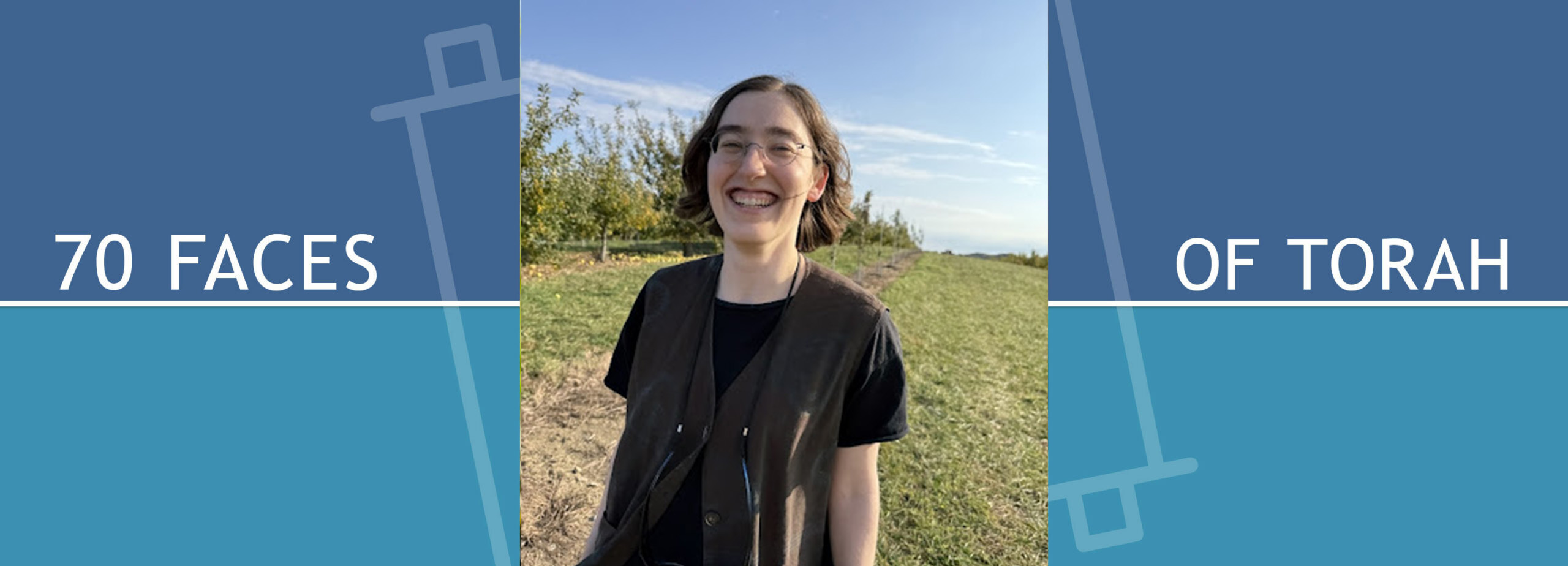
Chaim Spaulding (they/them) is a Shana Dalet rabbinical student at Hebrew College. They love liturgy and Talmud, and they are passionate about helping people access rigorous Jewish learning, creativity and playfulness, difficult conversations, and grief. Outside of school, they like to write, hike, lift weights, sing, nurture local and long-distance friendships, and curl up with tea and a good book.
Support Our Work Explore Graduate Programs Tamid Adult Learning Classes