

Rosh Hashanah Between Transformation and Grace
I am feeling, particularly profoundly this year, the hopefulness of this season in our sacred calendar. Faced with the oncoming winter, shortening days, fallow land, uncertainty whether the fall harvest will carry us through a period of fallow land – confronting, in essence, our mortality – our ancestors acknowledged futility but embraced possibility. Though respectful of the pull of life’s senselessness, they nevertheless trusted and affirmed, persistently and resiliently, that our lives matter, that we have a role to play, and that it is never too late.
Teshuva is one of the most hopeful and life affirming Jewish values and practices. It teaches that wherever and however we are, we can return, we can grow, we can transform. We can be better. We can put our lives more fully in service of God, of that which is most holy, the Source of all that animates and unites us.
At the same time, we pair teshuva with the faith that no matter what, regardless of how successful we are at our processes and practices for change, God loves us and forgives us. That is the implicit message of beginning Kol Nidre and Yom Kippur by reliving the scene from Numbers when, out of fear, we lose faith in God and do not go into the Land. Moshe intervenes on our behalf, begging God for forgiveness although we have done nothing to earn it, pleading, in essence, “You are a forgiving God, that is who You are. Please forgive us.” And God replies, “Salachti kidvarecha.” I forgive you as you have asked. (Numbers 14:20)
We live between and within these twin impulses and faiths – that we can and must change, and that we are loved unconditionally and forgiven graciously just as we are. Both are true and vital to our lives and the world. Both are essential for hope and replenishment.
In your personal work in this season of renewal, may you dig deep in your self, receiving the hopeful energy of teshuva that this time of year makes available, as you are able, to help you live more closely with God and walk more fully in Torah’s loving ways. And may you also open your heart to receive the unending and unconditional flow of God’s love and acceptance, reminding you that you are worthy of your life and place in this world, no matter what.
Rabbi Daniel Klein `10, MJEd`10 is Dean of the Rabbinical School of Hebrew College in Newton, MA. He previously served as Dean of Students and Director of Admissions at the College.
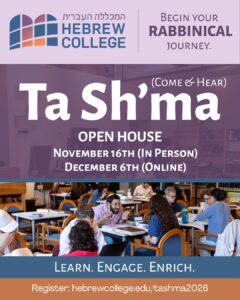 Meet students and faculty at one of our fall open houses, Ta Sh’ma (Come & Hear) November 16 (in-person) or online (Dec. 6).
Learn more and register.