

Faculty Rabbi Jane Kanarek Receives Honorary Doctorate
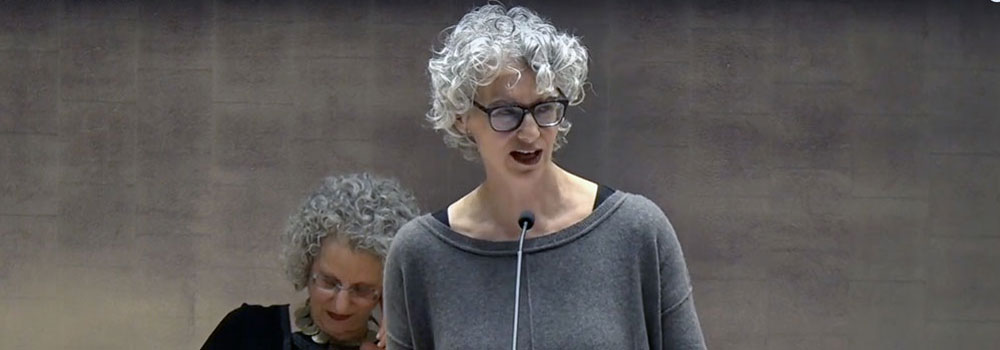
On March 3, 2025, Rabbi Jane Kanarek, Hebrew College Dean of Faculty and Professor of Rabbinics, received an honorary doctorate at the Jewish Theological Seminary’s Convocation. Read an excerpt of her remarks below, which speak to Hebrew College’s mission to reimagine Jewish learning and leadership for an interconnected world, making our lives more meaningful, our communities more vibrant, and our world more whole.
Many years ago, when I applied to rabbinical school, I wrote about the rabbi as teacher. I wanted to teach Talmud and I wanted to teach as a rabbi. I have indeed been blessed to spend much of my rabbinate as a teacher of rabbinical students, albeit at a different rabbinical school.
Yet, much as I have become rabbi-as-teacher, my vision of the rabbinate — for myself and others — is appropriately now much more expansive than the very limited purview of a twenty-three year old. (Parenthetically, 23 is probably much too young an age to begin rabbinical school!) As I have studied, written, and taught, worked in the pulpit and at Camp Ramah — two other commitments have come to lie at the heart of my rabbinate. These dual commitments are articulated in tractate Sotah of the Babylonian Talmud, by our ancient talmudic sages Rabbi Meir and Rabbi Yohanan. For full disclosure, I came across this teaching because I have been writing a book on Bavli Sotah (coming out in the fall).
“Said Rabbi Yohanan in the name of Rabbi Meir: Anyone who does not accompany another or who does not permit himself to be accompanied, it is as if he spills blood.”
אמר רבי יוחנן משום רבי מאיר כל שאינו מלוה ומתלוה כאילו שופך דמים(B. Sotah 46b).
This aphorism grows out of a larger discussion about the eglah arufah ritual, a procedure in which a heifer is slaughtered in order to atone for a corpse found in the open where the murderer remains unidentified. As part of this ritual, the elders of the town closest to where the corpse is found make the following declaration: “Our hands did not shed this blood, nor did our eyes see it done. Absolve, O LORD, Your people Israel whom You redeemed, and do not let guilt for the blood of the innocent remain among Your people Israel.”
The Babylonian Talmud turns these words from the book of Deuteronomy into a larger statement about how we care for one another. It would not be possible, the Talmud posits, for the elders of the town to be guilty of bloodshed. Why, then, do the elders declare that they did not shed the murdered person’s blood or see the crime committed? The Talmud answers its own question by rewording the elders’ declaration. What the elders really say is as follows: “[The murderer] did not come to our hands and we dismissed him without food; we did not see him and leave him without accompaniment [on his journey].” The elders declare that they did not fail in their task of care for travelers. They provided food and they provided accompaniment, protecting the lives of traveling strangers.
Rabbi Yohanan and Rabbi Meir thus intend their aphorism quite literally: Anyone who does not escort another person on a physical journey or who does not allow himself to be escorted, potentially exposes the traveller (whether the other person or himself) to a life-threatening situation.
Their teaching articulates two different responsibilities: first, a duty to accompany another person on a journey; and second, a duty to allow oneself to be accompanied by another person. This journey may be relatively brief — as the Talmud says to the city limits — or even quite extended — either without limit or 3 parasangs (about 10 miles).
Each of us enacts these words of Rabbi Meir and Rabbi Yohanan. Whether working as congregational rabbis, as chaplains, with college students, in day schools, as spiritual advisors, or as activists, we have had to walk with our people. We met our congregants wherever and whoever they are, in mundane moments as well as moments of rejoicing and moments of sorrow. We imagined with them visions for where they might choose to go, and accompanied them on these journeys. This is joyful work and it is not easy work. Indeed, Rabbi Meir also teaches that the reward for accompaniment is without measure.
Although the Talmud imagines two people walking together on a journey, we also know that as rabbis we walk both with individuals and with communities. In the past five years, we have had to walk with our communities through the Covid-19 pandemic, through the rise in anti-semitism, and through October 7 and its tragic aftermath. Within our increasingly fractured and fracturing society, we have had to face the difficult task of teaching our communities how to cohere even in the face of seemingly insurmountable differences. As rabbis, we are those who teach our communities how to foster and enact accompaniment as a kind of care that binds us together.
Rabbi Meir and Rabbi Yohanan, however, were not only concerned with our duty to care for others. They were also concerned with our duty to allow ourselves to be cared for, to be accompanied: כל שאינו מלווה ומתלווה כאילו שופך דמים — anyone who does not accompany others or accept accompaniment is considered to shed blood. Again, they meant this quite literally: that each of us needs to accept an offer of physical escort. I, again, want to take this statement a bit less literally. For the Talmud also teaches that when someone lacks a physical escort, that person should occupy herself with Torah.
I have learned that an essential aspect of being a rabbi is the ability to cross gaps . . . This I have come to believe is a crucial aspect of the rabbinate: cultivating the ability to becoming a gap-crosser. Crossing gaps does not necessitate giving up one’s beliefs; on the contrary — in order for me to meet someone who stands in a different place than I do, I must know what I believe. But I must also believe that this other person understands and knows things that I do not understand and know. What can I learn from this other person? How might their knowledge, and beliefs shape and reshape what I think I know? And even more, how might I help to create a communal framework that enables us to find a meeting-place in the gap between us?
As rabbis, we must create and sustain communities across difference. This is always vitally important work, but now it has become crucial. We are tasked with cultivating communities that find anchors of agreement which enable us to thrive with difference; to meet, care for, and accompany one another — with dignity — across gaps of generation, politics, and identity. Acts of accompaniment sustain our world.
Listen to the full version of Rabbi Kanarek’s remarks here.